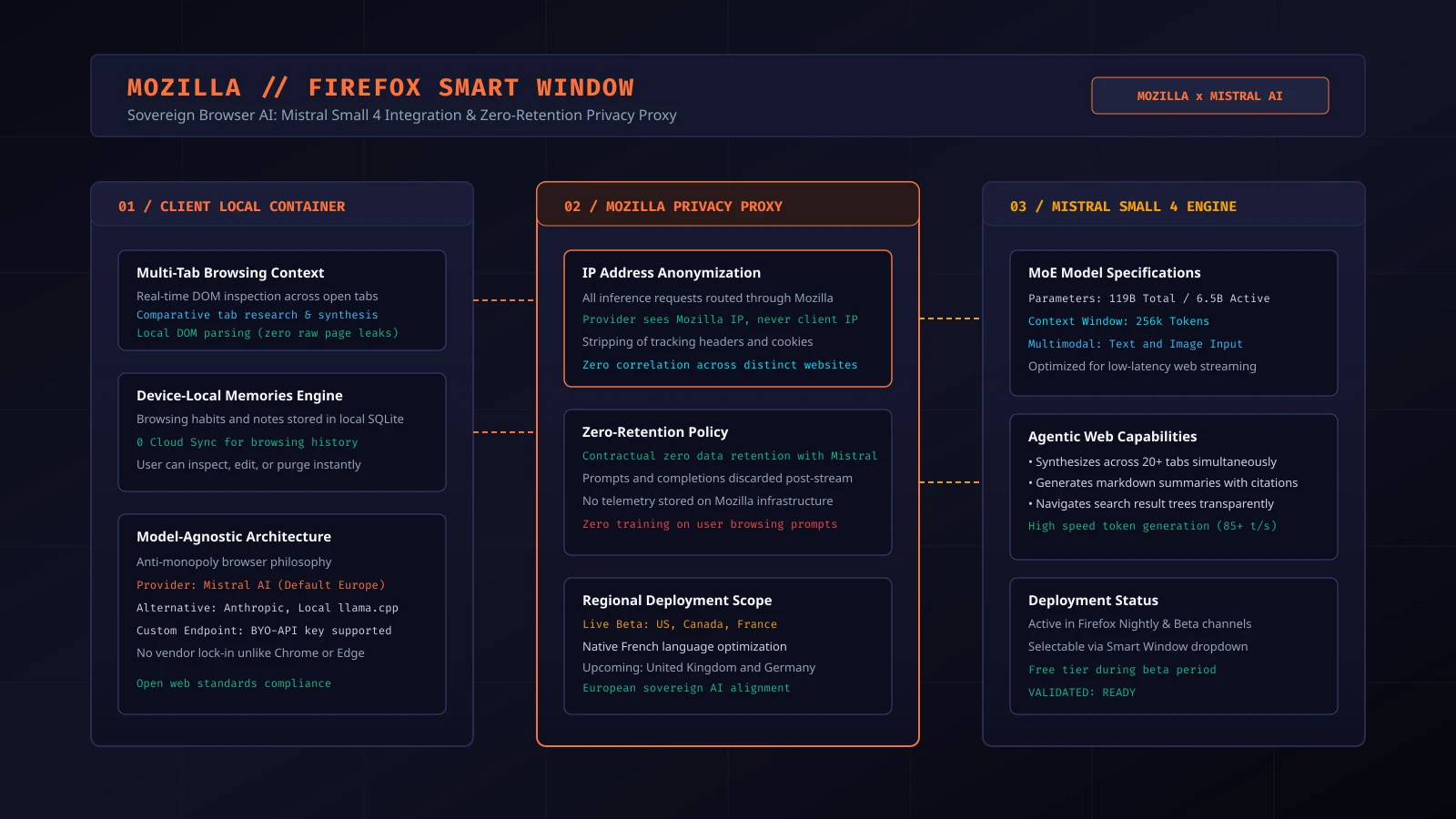
Mozilla Partners With Mistral AI to Bring Mistral Small 4 to Firefox Smart Window
Mozilla Partners With Mistral AI to Bring Mistral Small 4 to Firefox Smart Window
The commercial web browser has become the primary battlefield for artificial intelligence distribution. Google embedded Gemini directly into the Chrome browser frame, as detailed in our analysis of Claude in Chrome and Browser Agents, while Microsoft tied Windows and Edge to Copilot. For users seeking browser-level AI assistance, these implementations created a troubling dilemma: submit complete browsing history and page contents to proprietary advertising platforms, or forgo AI synthesis entirely.
On September 16, 2026, Mozilla announced a landmark technical partnership with French AI laboratory Mistral AI. The agreement integrates the Mistral Small 4 model into Firefox Smart Window, Mozilla’s native agentic browsing assistant currently in beta.
The collaboration introduces a sovereign European model alternative to US hyperscaler ecosystems, backed by strict contractual privacy guarantees: zero data retention on model endpoints, IP address stripping through Mozilla privacy proxies, and device-local memory storage.
What Mistral Small 4 Brings to the Browser
Mistral Small 4 is an optimized Mixture-of-Experts (MoE) model engineered specifically for high-throughput, low-latency reasoning on multimodal content:
- Parameter Architecture: 119 billion total parameters, with only 6.5 billion active parameters per token pass.
- Context Capacity: 256,000 tokens of working memory, enabling simultaneous ingestion of dozens of active browser tabs.
- Multimodal Ingestion: Native processing of both HTML text elements and rendered graphical imagery, such as data charts and visual documentation.
- Execution Speed: Benchmarked at over 85 tokens per second on distributed inference clusters, allowing real-time streaming summaries while a user reads.
Within the Firefox Smart Window interface, Mistral Small 4 powers multi-tab comparative synthesis. Rather than restricting questions to the active tab, the assistant can read across multiple open documents, extract conflicting technical specifications, and retrace multi-step research journeys.
Privacy Architecture: The Zero-Retention Proxy
Browser integration of AI models poses immense privacy hazards because web pages contain session cookies, personal account details, and private corporate intranets. Mozilla engineered a three-tier architectural shield separating raw browsing data from upstream model inference:
Firefox strips session tokens, authorization headers, and hidden form fields locally before extracting document text. Browsing memories are stored in an encrypted local SQLite database.
Inference requests route through Mozilla proxy relays. Upstream providers see a generic Mozilla network IP, preventing user fingerprinting or ISP correlation.
Mistral streams token completions back to the client. Prompts and completions are immediately purged from server RAM with zero logging and zero model training.
Architectural Comparison: Browser AI Platforms
The architectural differences between Firefox Smart Window and rival hyperscaler browser assistants highlight conflicting commercial priorities:
Browser AI Feature and Privacy Comparison
| Architecture Feature | Firefox Smart Window (Mistral Small 4) | Google Chrome (Gemini Integration) | Microsoft Edge (Copilot Sidebar) |
|---|---|---|---|
| Default Model | Mistral Small 4 (119B/6.5B MoE) | Gemini 1.5/2.0 Flash variants | GPT-4o / Prometheus pipeline |
| Model Agnosticism | Model-flexible; supports BYO-API key | Locked to Google Gemini models | Locked to Microsoft Copilot |
| Data Retention | Strict contractual zero retention | Tied to Google account history | Tied to Microsoft telemetry profile |
| IP Address Visibility | Masked via Mozilla privacy proxy | Visible to Google ad infrastructure | Visible to Microsoft Bing telemetry |
| Training on User Prompts | Strictly prohibited by policy | Subject to account tier settings | Used for service improvement |
| Memory Storage Location | Encrypted local SQLite file on device | Google Cloud sync account | Microsoft Cloud user profile |
| Active Deployment Scope | US, Canada, France (Beta) | Global rollout | Global rollout |
Regional Rollout and Sovereign AI Context
The beta release of Smart Window with Mistral Small 4 launched simultaneously in the United States, Canada, and France. In France, the launch carries native French language optimization, reflecting Mistral’s linguistic roots. Mozilla confirmed plans to expand the service to the United Kingdom and Germany later in 2026.
This release represents a strategic shift toward sovereign AI infrastructure. By partnering with Mistral, Mozilla proves that modern browser assistants do not require total capitulation to integrated advertising monopolies. Building on Mistral’s technical evolution with the Mistral Agentic Search Toolkit, the model architecture demonstrates competitive parity with Silicon Valley flagships while respecting European Union regulatory and privacy standards.
Practical Recommendations for Developers
Engineers testing the Firefox Smart Window beta should keep three practices in mind:
- Verify Local Memory Boundaries: Inspect
about:preferences#privacyinside Firefox Nightly or Beta to manage stored assistant memories. Confirm that internal corporate domains are added to the exclusion list. - Tab Budgeting: While Mistral Small 4 supports a 256k context window, performance remains optimal when synthesizing across 10 to 20 tabs. Excessively large sets of tabs increase token transmission latency over the proxy relay.
- Bring-Your-Own-Endpoint Option: Developers requiring dedicated private infrastructure can point Smart Window toward self-hosted vLLM or Ollama instances, using Firefox as an open, customizable AI workstation.
Conclusion
The integration of Mistral Small 4 into Firefox Smart Window provides an important technical blueprint for the future of agentic web browsing. By combining high-performance open-weight model architectures with zero-retention privacy proxies and local memory storage, Mozilla and Mistral establish that browser-level AI assistance can coexist with fundamental digital privacy.