GLM-5.3-Flash: Near-Opus 4.8 Coding Performance at a Tenth of the Cost — Weights on Hugging Face, MIT Licensed
The open-weights race just got its most aggressive entry of the month. Z.ai has released GLM-5.3-Flash, the first natively multimodal model in its GLM-5 series, and the headline numbers are hard to ignore: 320B total parameters with just 18B active, a 1M-token context window, and full weights published on Hugging Face under an MIT license. The company claims the model approaches Claude Opus 4.8 on coding and agentic benchmarks — at roughly a tenth of the cost.
What Happened
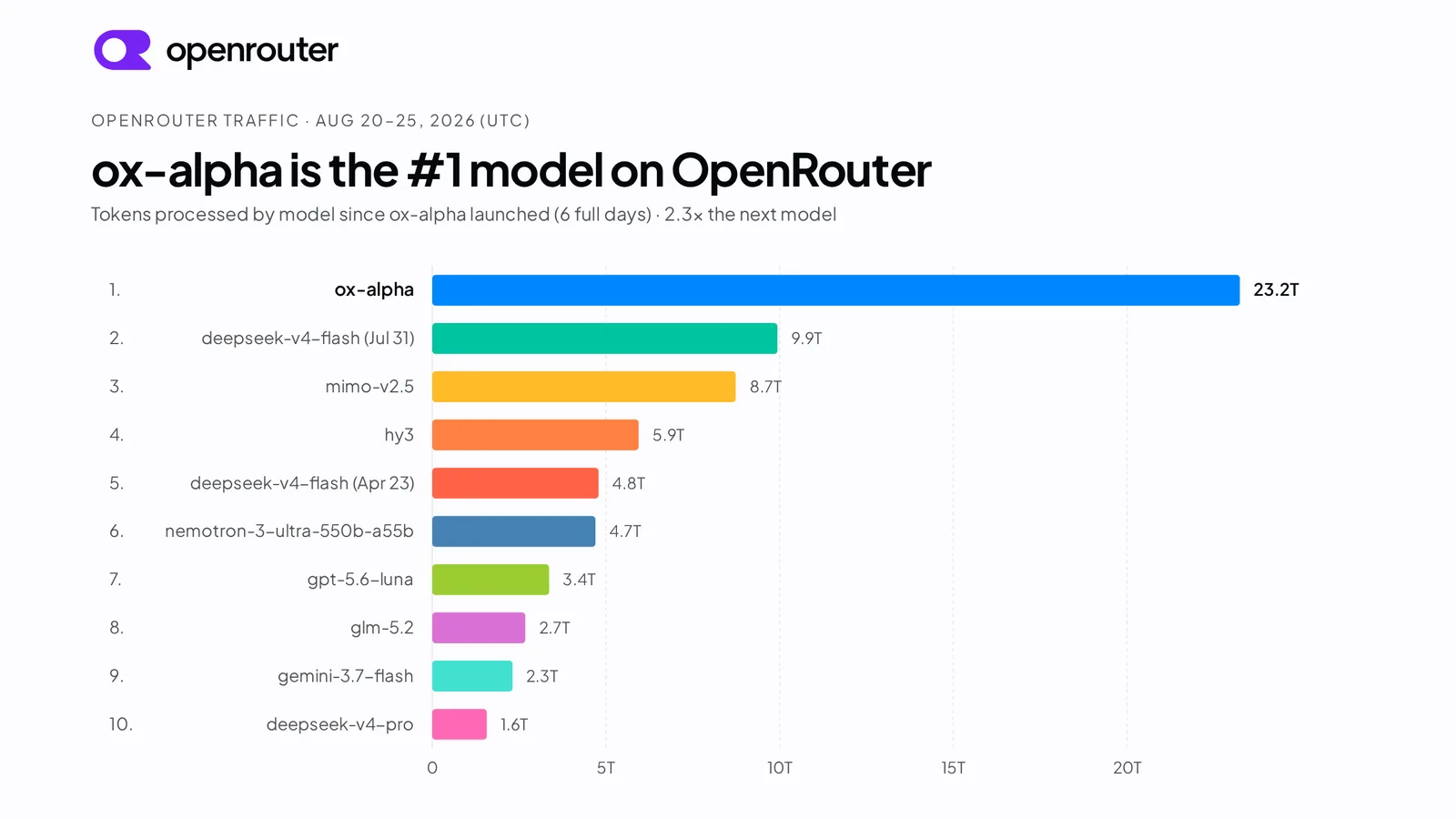
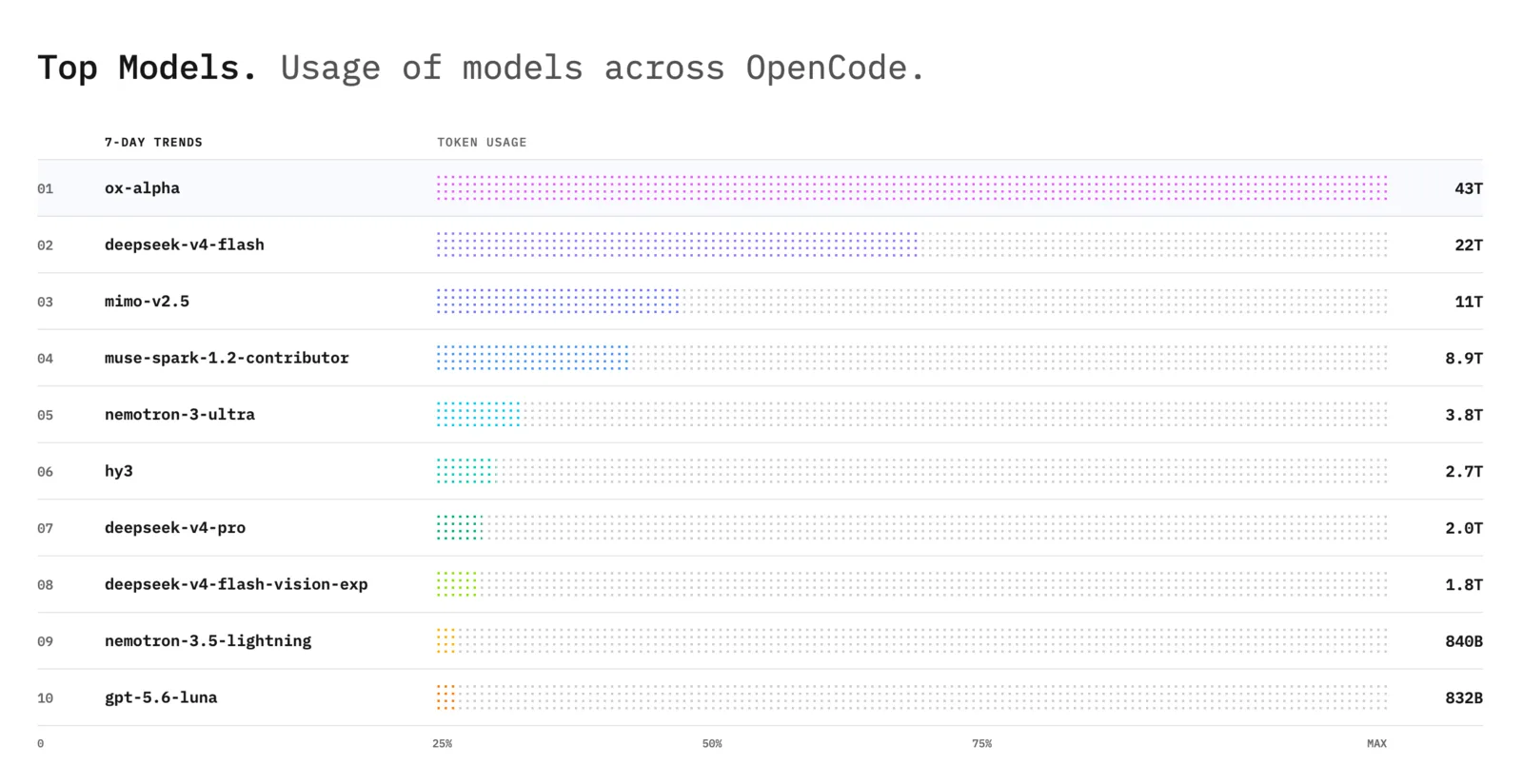
Z.ai announced the model on August 26, 2026 in a post titled “GLM-5.3-Flash: Frontier Intelligence, Flash Cost,” with API access live from day one. The more interesting story happened before the announcement: the company tested the model anonymously under the codename ox-alpha on OpenRouter and OpenCode, where it became the most-used model of its launch week — 23.2T tokens processed on OpenRouter, 2.3x the next model, and 43T tokens on OpenCode. All of that traffic, Z.ai notes, was served on Chinese AI chips.
Within days of launch, the full weights landed on Hugging Face under MIT. That’s a meaningful contrast with GLM-5.3 (the non-Flash flagship), which launched on August 14 without weights, pending a safety evaluation — the Flash variant shipped open from day one.
Why It Matters
Three reasons this release matters more than a routine version bump:
First, agent economics. Agentic coding workloads burn millions of tokens per task. A model that approaches frontier-tier per-task performance at a tenth of the cost changes the ROI math for anyone running agents at scale. Z.ai’s claim: GLM-5.3-Flash pushes the Pareto frontier of the Artificial Analysis Intelligence Index (v4.1.1), scoring 57 points at $0.045 per task (discounted) — a level of intelligence that previously cost roughly 10x more, per the company’s own numbers.
Second, the open-vs-closed gap is genuinely narrowing. In Z.ai’s published table, GLM-5.3-Flash lands near Claude Opus 4.8 on several axes: on Z.ai Code Bench (run inside Claude Code 2.1.207 at max effort) it scored 29.0 vs Opus 4.8’s 29.5, and it beat Opus 4.8 on DeepSWE v1.1 (63.4 vs 58.0) and AutomationBench (48.8 vs 41.0). These are vendor numbers and deserve methodological caution — but they’re consistent with the community’s enthusiastic reception of ox-alpha before the reveal.
Third, the license. MIT means: use it, modify it, embed it in a commercial product, no strings. For organizations that need full ownership of their AI stack — governments, enterprises, labs — that’s the strongest part of the story.
The Architecture Changes
GLM-5.3-Flash starts from a newly trained base model rather than being a distilled GLM-5.3, with significant architecture redesign:
- Hybrid attention. For the first time in the series, the model combines linear attention (capturing local dependencies via state modeling) with sparse attention (retrieving relevant global context through a lightweight indexer). Reported result vs GLM-5.3: 3.0x less attention compute and 4.4x smaller KV cache.
- mHC (Manifold-Constrained Hyper-Connections) for improved scaling efficiency.
- Far fewer layers: 45 vs 92 in GLM-4.5, despite a similar total parameter count.
- Multimodal training from the start: a 30T-token multimodal pre-training corpus spanning text, images, and video. The model reads screenshots, documents, and dashboards directly as images — which is exactly what computer-use and UI-testing workloads need.
The Numbers — and Who Measured Them
Z.ai’s official table includes comparisons against DeepSeek-V4-Vision-Exp, GPT-5.6 Terra, Gemini 3.7 Flash, and Claude Opus 4.8. The numbers worth pinning (all vendor-measured):
| Benchmark | GLM-5.3-Flash | GLM-5.2 | Claude Opus 4.8 |
|---|---|---|---|
| Terminal Bench 2.1 | 84.3 | 81.0 | 85.0 |
| DeepSWE v1.1 | 63.4 | 46.2 | 58.0 |
| AutomationBench v1.0.6 | 48.8 | 26.2 | 41.0 |
| Toolathlon Verified | 78.4 | 59.9 | 76.2 |
A necessary methodological note: these are benchmarks published by the model’s creator, with evaluation settings the creator chose. That doesn’t make them false, but it doesn’t make them neutral either. Notably, the table itself includes the model’s losses — NL2Repo (56.3 vs Opus 4.8’s 69.7) and video benchmarks (MVBench 77.8 vs Gemini 3.7 Flash’s 82.2) — which is a modest positive signal for the table’s overall honesty.
How to Try It
Three paths are live today:
# Via Ollama (cloud-hosted, zero data retention)
ollama run glm-5.3-flash:cloud
For self-hosting, the Hugging Face weights are supported by SGLang, vLLM, Transformers, and KTransformers. On the API side, the full guide lives in Z.ai’s developer docs, and the model is already selectable inside popular agent tools — Ollama lists it as a one-command option for Claude Code, OpenCode, and others.
Limitations
- Vendor benchmarks. Until independent evaluations land, treat the Opus 4.8 comparisons as a strong marketing claim, not settled fact.
- Real gaps exist. Video understanding and huge-repo work (NL2Repo) remain areas where competitors lead.
- 320B total parameters is not laptop-”Flash.” The savings are in active parameters and serving cost, not in home-hardware requirements.
What Developers Should Do
If you build on coding agents, spend an hour running the model on your actual workload: same tasks, same harness, then compare cost per completed task — not published benchmarks. That’s the number GLM-5.3-Flash is engineered to win on. If your organization wants an open foundation for internal AI capabilities, the MIT license plus full weights make this an obvious shortlist candidate.