SourceHut Overhauls Terms of Service to Prohibit LLM-Generated Code and AI Crawlers
SourceHut Overhauls Terms of Service to Prohibit LLM-Generated Code and AI Crawlers
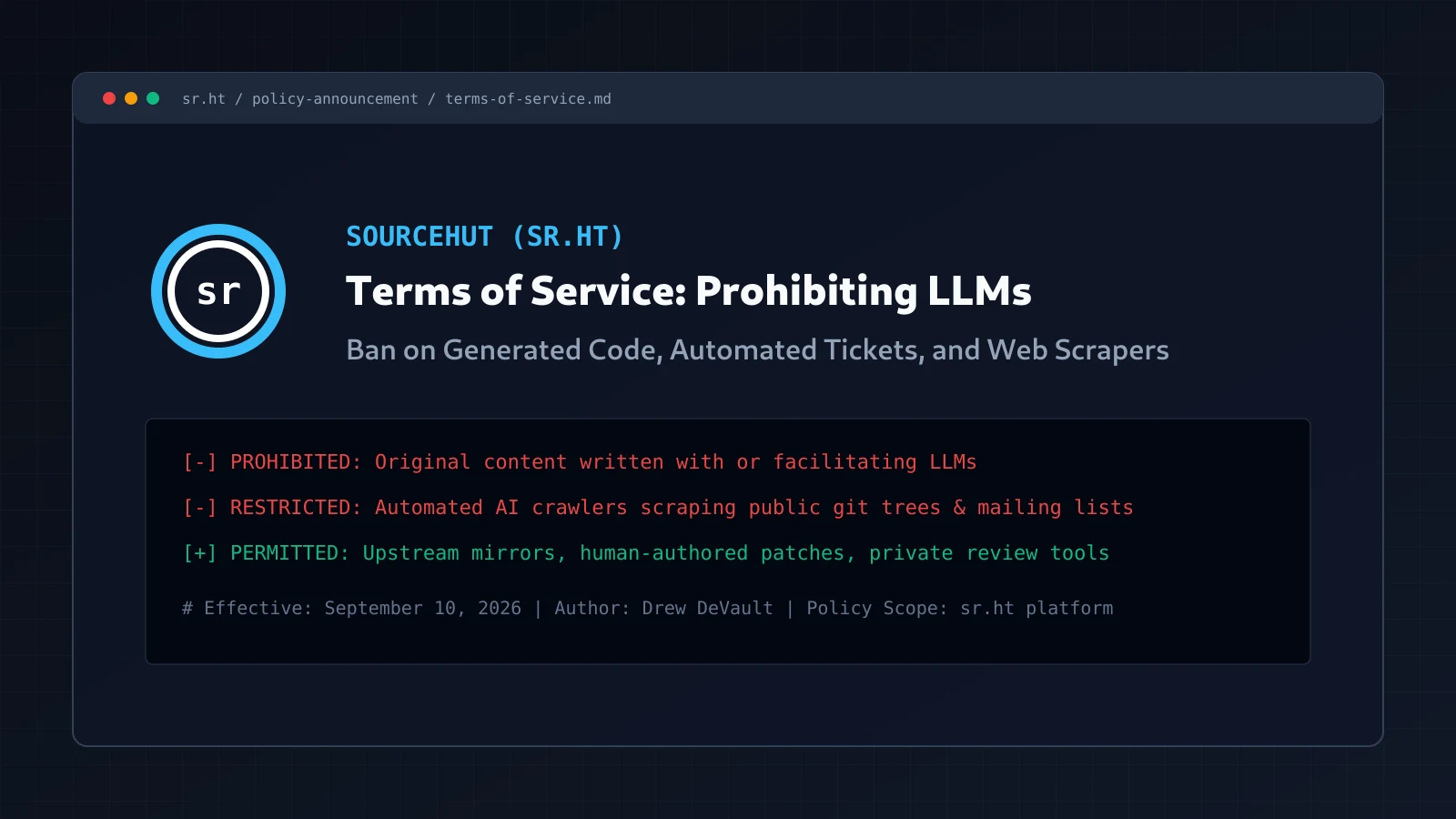
Independent open-source software forge SourceHut, led by developer Drew DeVault, has announced an overhaul of its Terms of Service. Effective September 10, 2026, the platform will ban original source code, issue tracker tickets, and mailing list patches produced or assisted by large language models (LLMs) and generative artificial intelligence tools.
The policy follows a similar move by European code forge Codeberg in late July 2026, signaling a growing divergence in the software forge ecosystem. While commercial platforms such as GitHub and GitLab continue embedding generative coding assistants directly into their web interfaces and pull request pipelines, independent and community-run platforms are establishing explicit boundaries against automated code generation. These concerns reflect wider friction around autonomous tooling security and intellectual property, echoed in ongoing disputes like the Sony and Warner Chappell lawsuit against Anthropic and developer vulnerabilities explored in GitSpawn’s analysis of coding agent attack vectors.
- Direct commit of code generated or co-authored by LLMs
- Automated or LLM-assisted bug tickets and support threads
- Patch emails generated by coding agents to mailing lists
- Unregulated commercial AI crawlers scraping public git trees
- Repositories created primarily to train generative models
- Mirrors of upstream projects that permit AI (e.g., Linux kernel staging)
- Personal private queries to LLMs for conceptual explanation or security review (with human-written commits)
- Standard automated CI test suites and deterministic linters
- Non-generative static analysis and compiler tooling
The Rationale Behind the Prohibition
The decision follows extensive public consultation across the SourceHut community mailing lists. In his policy brief, DeVault categorized the driving factors into operational sustainability, legal licensing integrity, and developer ecosystem health.
1. Infrastructure Resource Drain and “Vibe Coding”
Independent hosting platforms operate on tight hardware margins. SourceHut highlighted that projects developed entirely through generative prompting, frequently termed “vibe coding”, display distinct anomalous patterns in resource consumption:
- Overly complex continuous integration (CI) pipelines that exhaust build runner minutes on low-value commits.
- High commit frequencies with large code volumes that bloat distributed git object stores.
- Rapid abandonment cycles, where creators burn through shared infrastructure resources and abandon the repositories shortly after creation.
In parallel, aggressive web crawlers dispatched by artificial intelligence labs to scrape public git repositories and mailing lists cause recurring traffic spikes, degrading service availability for human developers and driving up bandwidth expenses.
2. Copyleft Circumvention and Software Licensing
A central ethical argument raised by SourceHut centers on intellectual property and open-source licenses. Generative models are trained indiscriminately on open-source codebases, frequently disregarding attribution mandates, patent grants, and copyleft clauses (such as the GNU General Public License).
DeVault specifically pointed to recent ecosystem disputes, including instances where proprietary actors used large language models to re-implement copyleft libraries under permissive terms, effectively laundering code to evade reciprocal licensing obligations. Under SourceHut’s perspective, hosting code generated by models trained without author consent directly undermines the sustainability of free software.
3. Maintainer Fatigue and Developer Deskilling
The flood of machine-generated contributions has imposed a severe review burden on open-source maintainers. Maintainers report spending increasing hours triaging plausible-looking but subtly broken code snippets, debugging fabricated edge cases, and responding to boilerplate bug reports submitted by automated agents.
SourceHut also cited research on cognitive deskilling, arguing that over-reliance on generative autocomplete reduces long-term software comprehension, architectural discipline, and independent problem-solving skills among newer engineers.
Policy Interpretation and Enforcement
Enforcing an artificial intelligence ban across thousands of git commits presents obvious practical challenges. Commercial text detectors and heuristic classifiers suffer from notorious false-positive rates and cannot reliably determine code authorship.
SourceHut outlined specific interpretation guidelines to avoid punishing genuine human contributors:
The “Original Content” Distinction
The prohibition applies specifically to original content authored for the platform. Developers can still host mirrors of external codebases that follow different policies. For example, contributors to the Linux kernel can maintain staging trees and patch queues on SourceHut without violating terms, even if other subsystems of the upstream Linux project contain AI-assisted patches.
Private Assistance vs. Machine Co-Authorship
Using an offline language model as a private reference, such as searching for documentation syntax, reviewing security considerations, or asking conceptual questions, is discouraged but not banned, provided the human developer writes the resulting implementation by hand. The violation occurs when the model produces the code, commit message, or ticket text that is pushed directly to the platform.
Case-by-Case Adjudication
Rather than deploying automated filters that reject pushes based on heuristic scores, SourceHut will enforce the policy on a case-by-case basis. Flagged accounts will be reviewed manually by platform staff, with maintainers given opportunities to provide context before administrative action or account suspension occurs.
Ecosystem Impact
The SourceHut policy change solidifies two diverging models for modern software development:
| Dimension | Hyperscale Commercial Forges (GitHub, GitLab) | Independent Forges (SourceHut, Codeberg) |
|---|---|---|
| Generative AI Position | First-party integration and revenue engine | Banned or strictly restricted by Terms of Service |
| Scraper Access | Authorized via commercial data licensing | Blocked or rate-limited via firewalls |
| Review Expectations | Automated AI reviews, summaries, and PR bots | Human-to-human technical evaluation |
| Resource Allocation | Scaled through cloud compute monetization | Preserved for deterministic builds and mailing lists |
| Licensing Stance | Considers AI training fair use under current law | Considers unconsented training license infringement |
For developers who value strict human peer review and cryptographic provenance, SourceHut’s policy establishes a safe haven. For projects relying on autonomous agent orchestration and automated code generation, migration to other hosting environments will be necessary before the September 10 deadline.