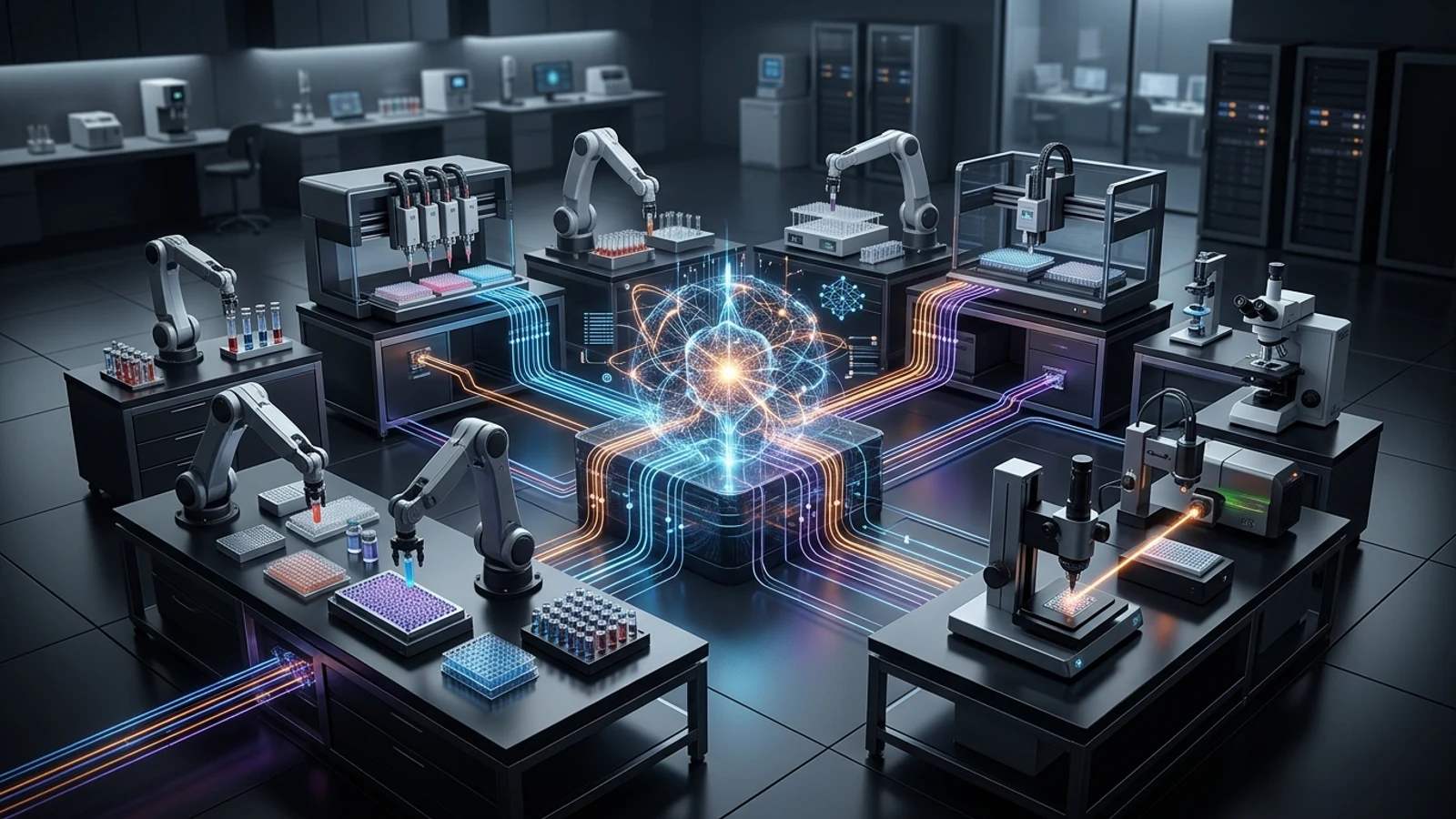
Anthropic Previews Model Hardware Standard (MHS): Bridging AI Agents to Physical Labs and Robotics
In pure software, the Model Context Protocol (MCP) standardized how language models talk to databases, external tools, and cloud APIs. But when an autonomous agent leaves the virtual screen to steer an automated wet lab or coordinate robotic manipulators on a factory floor, agent architectures hit a hard physical wall: instrument interfaces are fragmented, proprietary, and unstandardized—and mistakes in the physical world cannot be undone with a simple Ctrl+Z or an idempotent retry loop.
On August 27, 2026, Anthropic announced a research preview of the Model Hardware Standard (MHS): an open-intent shared specification and driver layer designed to let AI agents (such as Claude) safely discover, monitor, and operate programmable physical equipment.
The announcement signals a major architectural shift: turning lab and industrial automation from rigid, multimillion-dollar custom integrations into an open, agent-orchestrated infrastructure.
What Happened
Anthropic opened the MHS research preview to an initial cohort of scientific research institutions and advanced manufacturing partners. The initiative targets the notorious “integration plumbing” problem: connecting instruments from different vendors currently takes months or years of bespoke engineering, putting true closed-loop autonomous experimentation out of reach for most research teams.
MHS originated as a collaboration between Alek Kemeny on Anthropic’s Beneficial Deployments team and Arco Bast, a postdoctoral neuroscientist at HHMI Janelia Research Campus. Bast was operating a complex brain-imaging rig combining lasers, motorized focusers, and specialized cameras from multiple vendors that lacked a common interface. To eliminate manual bottlenecks, he built a shared memory dictionary enabling instruments to exchange telemetry at memory speed. Kemeny and Bast subsequently integrated AI models directly into that shared interface.
A broad ecosystem of hardware and software leaders is participating in the preview:
- Amazon Web Services (AWS): Providing preview participants access to
Strands Robots, its agent-to-physical-device connection library. - Automata: Embedding MHS into its
LINQlab automation platform for autonomous error handling. - Tecan: Enabling direct agent discovery and operation for its
Fluentliquid handling platforms. - QIAGEN: Demonstrating proof-of-concept automated instrument diagnostics and guided recovery on
QIAsymphony Connect. - Hugging Face & Raspberry Pi: Integrating MHS into the open-source
LeRobotrobotics library and rolling out camera driver support across Raspberry Pi hardware. - Doosan Robotics & Universal Robots: Validating multi-robot coordination and automated quality assurance on robotic arms.
How MHS Works: The Architecture
MHS decouples high-level experimental intent from low-level mechanical actuation across four clear layers:
Defines high-level scientific hypotheses, parameters, and desired experimental goals.
Translates abstract scientific workflows into deterministic machine instruction sequences.
Maps primitives to machine capabilities, enforcing immutable boundaries for maximum RPM, thermal ceilings, and collision avoidance.
Liquid handlers, centrifuges, robotic arms, thermal cyclers, cameras, and qPCR instruments.
1. Device Manifests & Network Discovery
Each MHS-compatible device publishes a machine-readable manifest defining:
- Read Primitives: What telemetry the machine measures (temperatures, optical densities, motor torque, fluid levels).
- Write Primitives: What actuators the machine exposes (aspiration rates, robotic arm joint angles, cycle counts).
- Hardware Safety Boundaries: Hard operational envelopes (maximum RPM, thermal ceilings, forbidden spatial collision zones) that cannot be overridden by model prompts.
2. Hardware-Independent Protocol Compilation
MHS allows experimental protocols to remain agnostic of specific hardware vendors. For example, a protocol can specify spinning down a 96-well plate at $15,000 \times g$ for five minutes without naming a specific centrifuge model. The orchestration layer (such as ResearchOS) queries the network via MHS for an available centrifuge, inspects its driver manifest to read its rotor radius, and uses Claude to compute the exact RPM parameters required by that specific machine geometry.
3. Closed-Loop Telemetry and Sensor Fusion
Instead of treating physical operations as blind batch jobs, MHS streams continuous sensor data—including real-time computer vision feeds and spectrometer readings—back into the agent reasoning loop. If an anomaly occurs during a protocol, the agent can intervene dynamically before an entire batch of biological samples is ruined.
Software Tool Calls vs. Physical Execution: The Bubble Case Study
In software agent workflows (like code execution or browser scraping), failure is cheap, silent, and idempotent. If an API call fails with HTTP 500, an agent simply retries with modified headers.
In the physical world, blind retries can compound catastrophic failures:
The Liquid Handling Foam Trap with Genentech
During pipetting trials at Genentech, Claude encountered optical read errors caused by micro-bubbles and foam in protein reagents. Without physical domain grounding, Claude’s initial instinct was standard software behavior: retry the aspiration in the same well with adjusted parameters. This additional agitation introduced more air, creating even more foam and ruining the well.
Once researchers provided context—explaining that the error code represented a physical fluid mechanics failure requiring gentle handling, fewer mixing cycles, or transferring the tube to a centrifuge to pellet the liquid—Claude retained that mechanical context. Anthropic codified these findings into reusable Physical Liquid Handling Skills, enabling the model to anticipate fluid viscosity and adjust aspiration velocities proactively.
Empirical Benchmark Results from Early Deployments
Anthropic and partner labs published concrete quantitative findings from early validation:
-
Dispense Precision Beats Manufacturer Specs: Across 9,143 individual dispenses, 300 unique transfer configurations, and 1,508 measured conditions across four distinct liquid types, Claude and MHS optimized multi-dispense predictions roughly 12% more accurately than the hardware manufacturer’s own technical specification sheet, beating the baseline on 31 of 45 runs (sign-test $p \approx 0.001$). On highly replicated data, accuracy gains reached 17%.
-
Automating De Novo Protein Screening at UW: At the University of Washington’s Baker and Pinglay labs, researcher Zihao Song deployed MHS to overcome testing bottlenecks in de novo protein design. While computational protein design costs pennies, wet-lab validation previously cost ~$100 and a week of manual labor per 1,000 candidates—requiring researchers to manually swap PCR plates every 90 minutes around the clock. By linking a robotic arm, liquid handler, and qPCR machine under MHS, the agent coordinated collision-free plate transfers and autonomously monitored amplification curves to halt reactions at optimal inflection points.
Physical Constraints and Limitations
Despite strong early results, physical deployment introduces distinct constraints:
- Spatial & Physical Intuition Gaps: LLMs learn the world via text tokens and 2D images; they lack native motor intuition and physical dynamics models. Expert human-in-the-loop validation remains essential for high-stakes protocols.
- Legacy Equipment Integration: Thousands of academic and industrial instruments lack digital network interfaces, requiring hardware bridges (such as Raspberry Pi-based MHS adapters) to participate.
- Biosafety and Misuse Governance: Autonomous execution of biological and chemical protocols demands rigorous safeguards. Anthropic is constructing a dedicated Physical Safety Roadmap with automated pre-execution filtering to prevent misuse or hazardous synthesis.
What Developers & Researchers Should Do
The transition to embodied software agents is accelerating. Here is how teams should prepare:
- Academic & Industrial Labs: Apply for access through the official MHS Research Preview Waitlist to test MHS on existing lab workcells.
- Robotics & Tool Developers: Open-source ecosystems like Hugging Face LeRobot and Raspberry Pi are preparing driver standards ahead of the public open-source specification release.
- Protocol Designers: Begin decoupling experimental definitions from proprietary machine software by adopting declarative, hardware-agnostic protocol definitions.