Claude in Chrome Is Generally Available: Your Browser Is Now an Agent Runtime
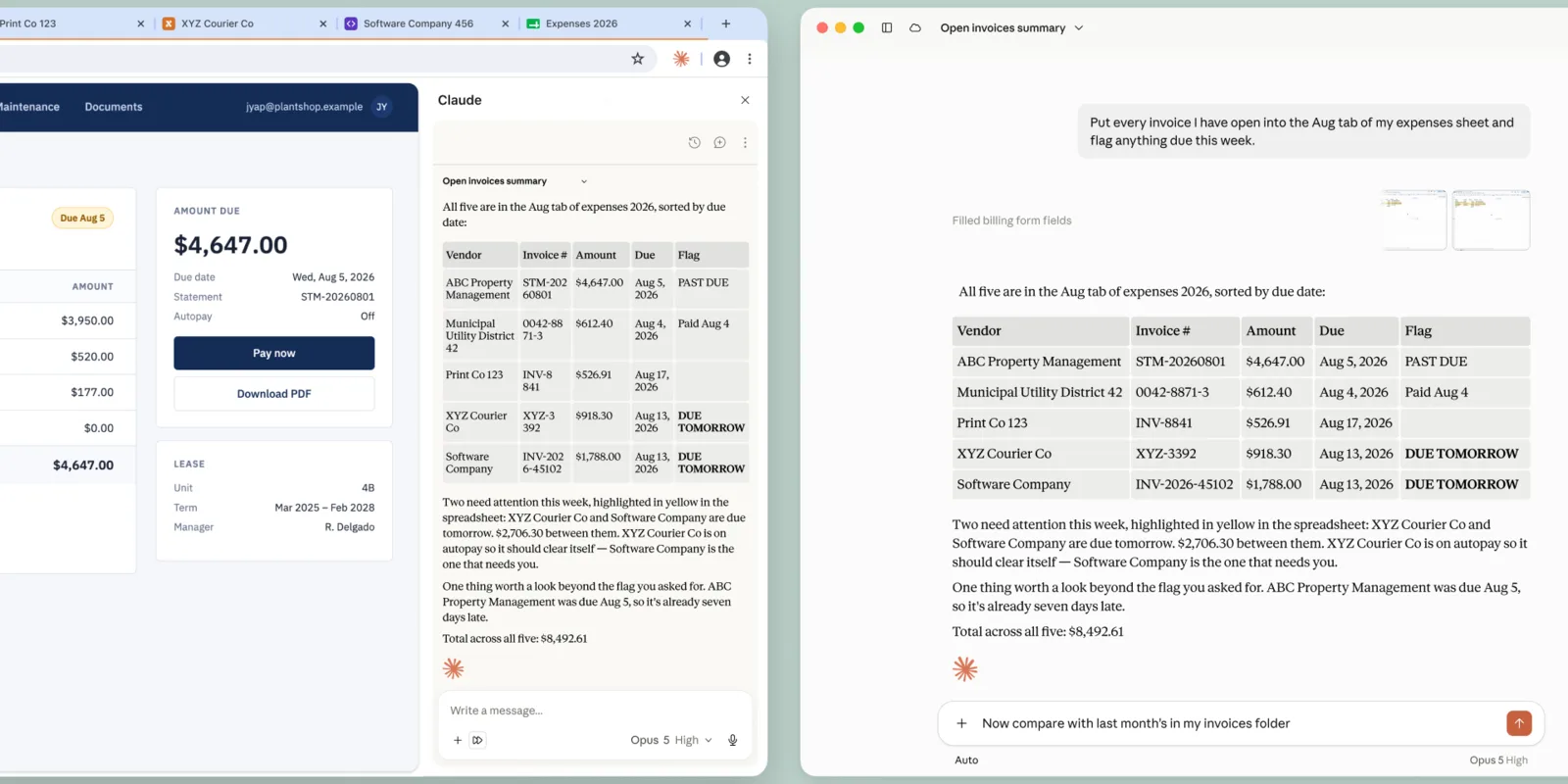
Nearly a year after its limited pilot, Anthropic announced on August 26, 2026 that Claude in Chrome is generally available on every paid Claude plan. But the headline understates the real story: alongside GA, Claude can now take actions in your browser autonomously — no per-click approval — backed by a safety classifier that validates each action before it executes.
What Actually Changed
The extension itself isn’t new. Anthropic shipped the pilot last year deliberately — to test the product while hardening it against prompt injection: malicious instructions hidden in pages, emails, or form fields that try to hijack an agent into doing something the user never asked for. What’s different in GA:
- Autonomous actions. Claude now auto-approves actions it deems safe, using the same mechanism as auto mode in Claude Code. Previously, every click and keystroke required your sign-off. You can switch back to manual approval in settings.
- An action-level safety classifier. Every action Claude is about to take — navigating to a site, typing into a page, submitting a form — is checked by a classifier against your original request. If the action doesn’t match what you asked for, it’s blocked.
- Wider reach. The extension works across tabs, the conversation continues from desktop, mobile, and web apps, and it reaches what connectors can’t: internal dashboards, legacy systems, vendor portals — the API-less applications where a large share of enterprise work still happens.
The Defense Stack: Three Layers Deep
The most interesting part of the announcement isn’t the feature — it’s the defensive architecture that made GA possible. Anthropic describes three layers:
- The model itself, trained against a constantly growing library of prompt injection attacks sourced from internal automated attackers, external red teams, and real-world monitoring. Every attack that succeeds gets added to the library and feeds the training of future models and deployed safeguards.
- Probes that screen web content before Claude acts on it. Every tool result — a page, an email, a form field — is scanned for likely injections; on detection, Claude is warned to treat the content with suspicion and check with you before proceeding. Probes first shipped with Claude Opus 4.5.
- The automatic-approval classifier described above, which blocks any action inconsistent with the user’s original request.
The published numbers back this up. On Anthropic’s current evaluation — stronger attacks sourced from professional red-teamers — no attacks succeeded against Claude Sonnet 5, Opus 5, or Mythos 5 when running with probes plus the safety classifier, and only 0.3% succeeded against Fable 5. For context: Opus 4.5 without the full safeguard stack saw a 17.6% attack success rate among attacks that reached the model. Anthropic notes it manually verified that all successful breaks were in low-severity scenarios.
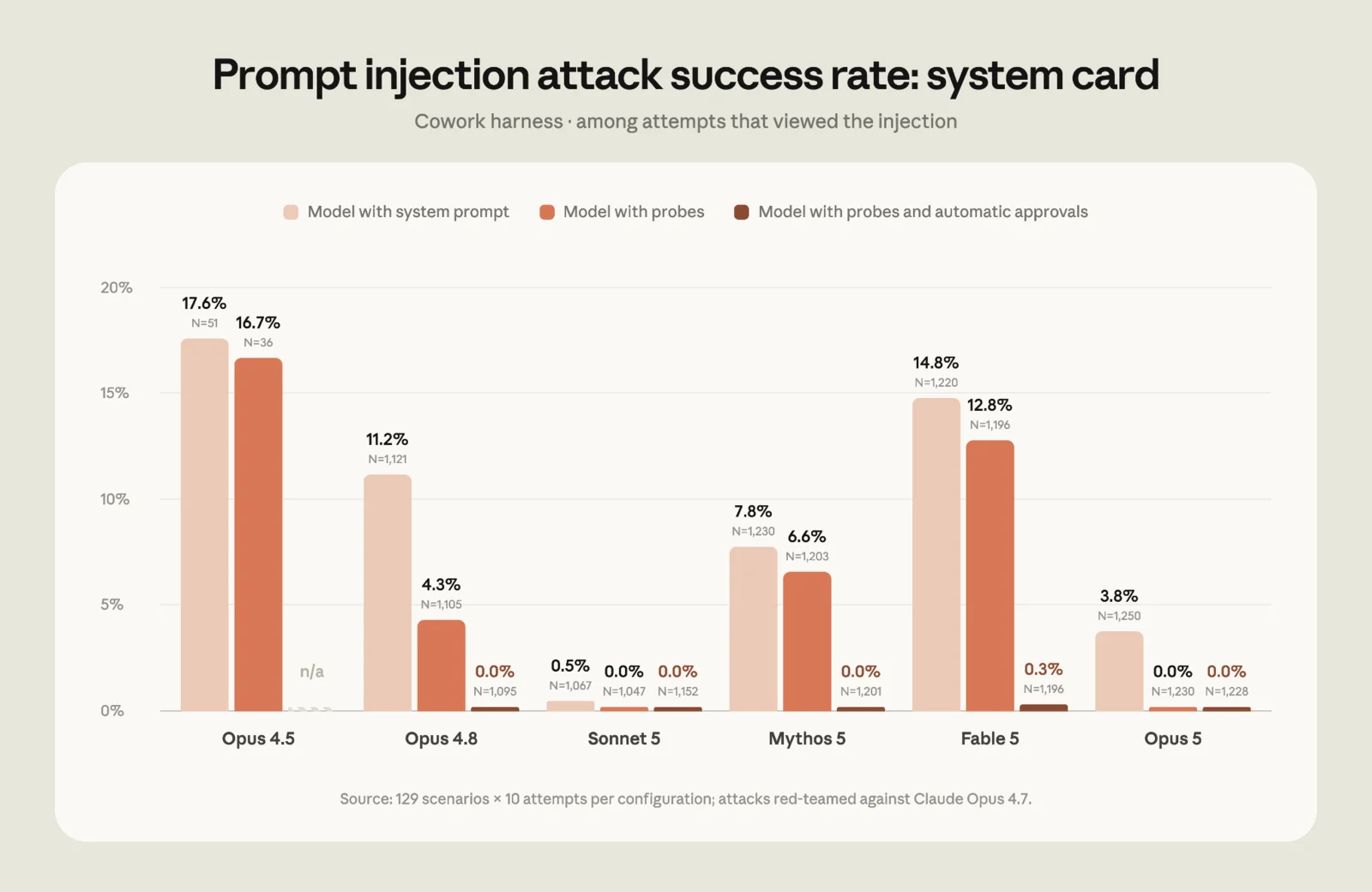
These are, as always, vendor-reported numbers, with methodology documented in the blog post and the Opus 5 system card. But even read conservatively, the trend is clear: the “browser agents get hijacked easily” gap is shrinking generation over generation.
Why This Matters for Developers
- The browser is now a deployment target. The biggest automation surface in most enterprises isn’t the API — it’s the applications without one. An agent that operates inside your browser with your existing logins makes previously out-of-scope workflows automatable: vendor portals, legacy internal systems, admin consoles.
- “Classify before execute” is the transferable engineering pattern. The hard problem for browser agents isn’t acting — it’s trusting the action. The pattern here: separate the decision “what to do next” from the decision “is this allowed right now,” comparing every action against the user’s original intent. That pattern ports to any agent you build; it isn’t Anthropic-specific.
- Zero successful attacks ≠ absolute safety. The evaluation covers 129 scenarios × 10 attempts per configuration, with attacks red-teamed against Claude Opus 4.7. Prompt injection remains, in Anthropic’s own words, a moving target — passing today’s evaluation doesn’t guarantee resistance to tomorrow’s attacks.
Practical Limitations
- Chrome only, no mobile yet. The extension doesn’t run on other Chromium browsers or on phones.
- Files and local apps stay out of scope. Working with files on your machine or applications outside the browser still requires the Claude desktop app.
- Enterprise governance is built in. On Enterprise plans, admins can manage the extension in Organization Settings and restrict it to approved domains — which is what makes managed enterprise rollout viable rather than ad-hoc individual use.
The Takeaway
With this launch, Anthropic completes the “agent in the work environment” loop: computer use for the screen (GA days earlier), browser use via API, and now Claude in Chrome for end users inside their own browser. The new race isn’t “strongest model” — it’s “which agent you can trust to run your tasks without watching over its shoulder,” and it was progress on exactly that benchmark which opened the GA door.