DeepSeek Adds Vision to Its Budget Workhorse: V4-Flash-Vision-Exp Is Live in Experimental Preview
After months on the sidelines of the budget-vision race, DeepSeek launched DeepSeek-V4-Flash-Vision-Exp on August 21, 2026 — the company’s first image-capable model in its Flash tier. It’s live now as an experimental preview under the model ID deepseek-v4-flash-vision-exp on the DeepSeek API platform.
What Happened
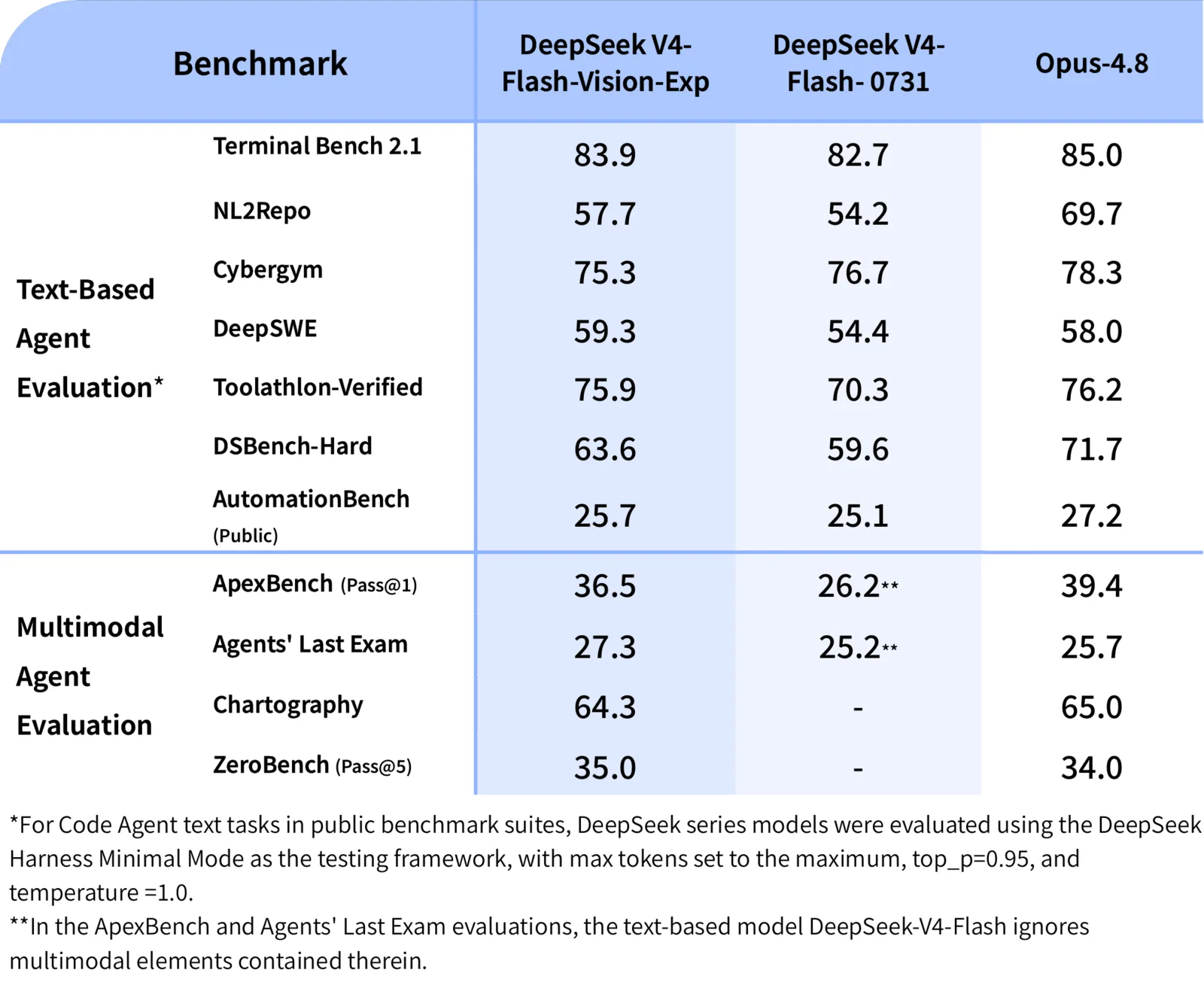
The new model keeps V4-Flash’s text capabilities — agents, reasoning, world knowledge — and layers vision on top. DeepSeek’s headline claim: on multimodal agent benchmarks, V4-Flash-Vision-Exp makes a major leap over V4-Flash and brings multimodal agent performance close to Claude Opus 4.8. The numbers are in the release post and, as always with launch-day charts, they’re vendor-measured.
The practical details are what make this launch notable:
- Unusual image pricing. Each image is tokenized at up to 384 tokens, billed at regular V4-Flash pricing. Many competitors charge hundreds to thousands of tokens per image depending on resolution. Reading an image here costs roughly what a paragraph of text costs.
- Three input paths: base64 inline, an external URL, or a one-time upload to the Files API referenced later by
file_id. - A free Files API launched alongside the model: upload an image once and reuse it across requests without re-sending bytes.
- Broad compatibility. Chat Completions, Messages, and Responses APIs are all supported — so OpenAI-format client code needs only a model-name change and an image content block.
Quick Start
from openai import OpenAI

client = OpenAI(api_key="...", base_url="https://api.deepseek.com")

response = client.chat.completions.create(
    model="deepseek-v4-flash-vision-exp",
    messages=[{"role": "user", "content": [
        {"type": "text", "text": "Extract this invoice into JSON"},
        {"type": "image_url",
         "image_url": {"url": "data:image/jpeg;base64,<BASE64>"}},
    ]}],
)
print(response.choices[0].message.content)
Supported formats: JPEG, PNG, GIF, and WebP — detected from file content, not the extension. Inline base64 data counts toward a 48 MiB request-body limit.
Why It Matters
Strategically, this closes a gap: DeepSeek was the last major budget-tier lab without vision. The “cheap text model + agents + eyes” loop is now complete, and the direct competition lands on document-and-screenshot agents — the most common vision workload in production. With images capped at 384 tokens at Flash pricing, workloads like processing thousands of invoices a month become trivially cheap to estimate: the cost approaches plain-text pricing.
If you already run V4-Flash in an agent stack, switching the model ID to the vision variant changes nothing about your text logic — DeepSeek states it matches V4-Flash on text capabilities — and opens UI-understanding use cases without any migration.
Limitations — Read Before Depending On It
- Explicitly experimental. The
-Expsuffix means behavior and pricing can change without a long notice period. Don’t put critical production paths on it yet. - 384 tokens is cheap, but it’s a detail ceiling. Dense documents and complex dashboards may lose reading accuracy versus vision models that bill at higher resolutions.
- “Close to Opus 4.8” is a vendor claim. Wait for independent evaluations before treating the comparison as settled.
What Developers Should Do
Test the model on three samples from your real workload: an invoice, a screenshot from your app, and a chart. Measure extraction accuracy and actual token spend. If the results hold up, you have the cheapest vision layer currently available for agents — with a fallback plan ready for the day the stable version ships or pricing changes.