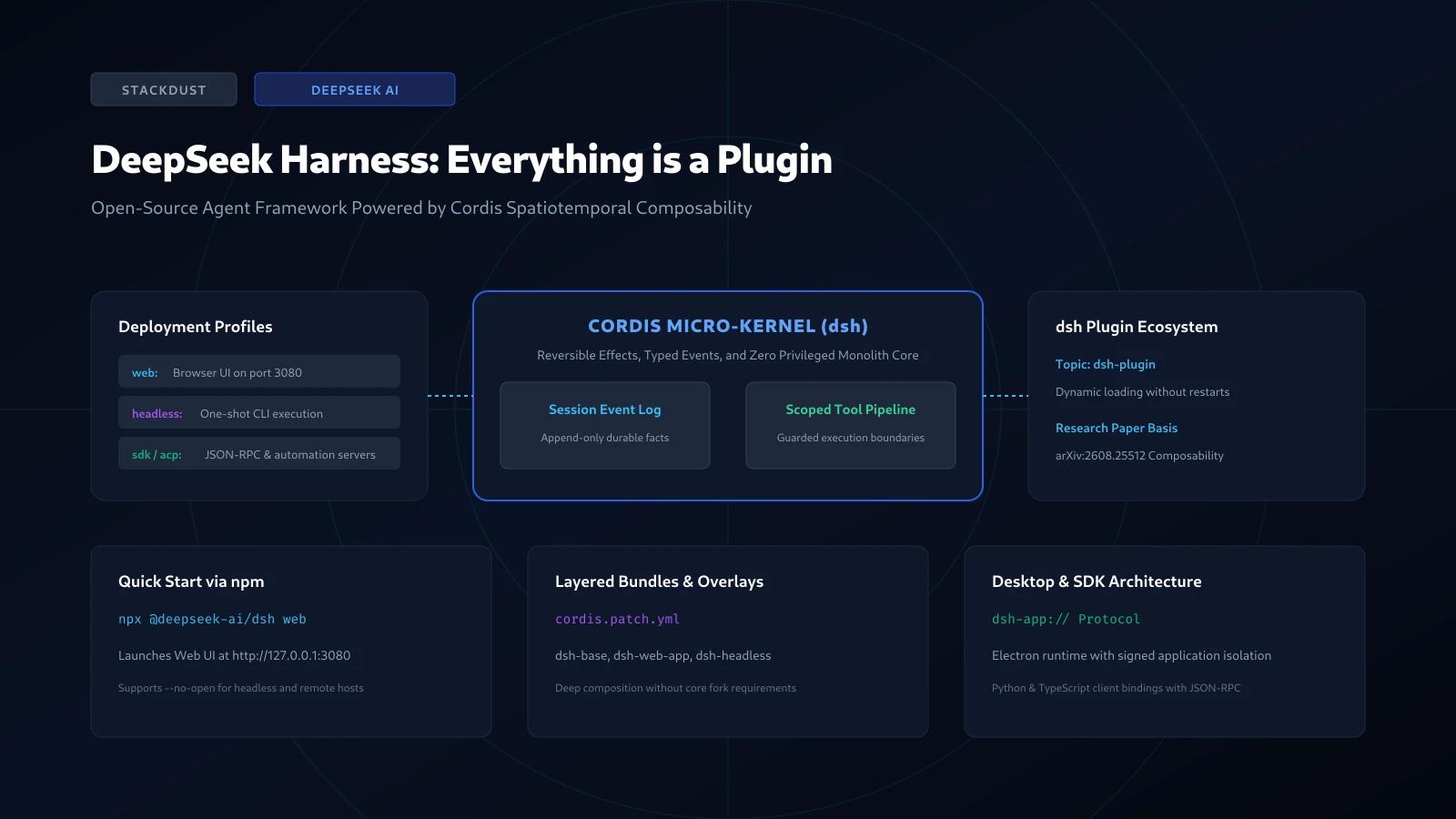
DeepSeek Harness: The Modular Agent Architecture Where Everything Is a Plugin
Most modern agent frameworks follow a monolithic design pattern. The central loop, tool dispatch mechanism, session state, and model client are hardcoded into an inflexible engine. When an engineering team needs to substitute the session storage engine, enforce enterprise sandboxing, or alter prompt assembly, they must fork the repository or maintain fragile runtime monkey-patches.
With the release of DeepSeek Harness (dsh), DeepSeek AI introduces a completely decoupled alternative. Built on the Cordis micro-framework, DeepSeek Harness operates on a strict everything-is-a-plugin architecture grounded in theoretical research on spatiotemporal composability (arXiv:2608.25512).
Under this design, there is no privileged internal core. The model adapter, tool registry, session log, and agent decision loop are all peer plugins that register typed events, inject scoped services, and unwind their effects reversibly upon unloading.
The Cordis Micro-Kernel and Reversible Effects
In traditional software, loading an extension often leaves permanent state mutations in global memory. If an extension registers a tool or modifies an event handler and subsequently fails, the parent process requires a restart to restore clean state.
DeepSeek Harness resolves this through Cordis contexts. Every plugin operates within an isolated context scope (ctx). Registrations are treated as transactional effects:
Plugin mounts beside peer services, publishing typed events and declaring required dependencies on the shared context.
Reads ordered bundles and applies declarative patches from cordis.patch.yml without altering vendor source code.
Executes agent turns through append-only session event logs and guarded tool pipelines.
When unmounted or hot-reloaded, all registered tools, hooks, and listeners unwind cleanly without process restart.
This mechanism allows developers to hot-swap prompt templates, replace model providers, or toggle telemetry backends at runtime without dropping active client connections.
Profiles and Bundles: Composing the Harness
DeepSeek Harness standardizes runtime environments into two abstractions: Profiles and Bundles.
- Profile: A named composition configuration stored in the Harness home directory (
$DSH_HOME/profiles/). It specifies an ordered list of bundles to mount, maintains user-installed external plugins, and applies localcordis.patch.ymloverrides. - Bundle: A packaged distribution of Cordis configuration entries and the executable code they activate.
The system ships with pre-configured profiles tailored for different deployment environments:
| Profile Name | Target Runtime | Primary Communication Interface | Typical Use Case |
|---|---|---|---|
web | Node.js Server | Browser UI at http://127.0.0.1:3080 | Interactive human-in-the-loop development |
headless | CLI Runner | Stdio stream with exit code | CI/CD automation and batch script tasks |
sdk | Background Daemon | Structured JSON-RPC server | Integration with Python and TypeScript apps |
acp | Automation Engine | Automation Control Protocol | Orchestrated agent swarms and headless worker pools |
desktop | Electron Application | Secure dsh-app:// IPC protocol | Sandboxed native workstation client |
To inspect the exact plugin resolution hierarchy that boots on a host:
# Dump the active profile plugin resolution tree
dsh --profile web --dump-config
Any single row returned by that dump can be patched, replaced, or disabled using a project-level cordis.patch.yml file.
Core Packages and Execution Boundaries
The framework splits responsibilities across modular packages located under packages/core/:
1. The Append-Only Session Log (core/session)
Rather than relying on volatile in-memory chat histories, session facts are recorded as immutable SessionEvent rows. If an agent process crashes or requires a state transfer to another machine, the session can be reconstructed deterministically by replaying the event log.
2. Scoped Tool Pipelines (core/tools)
Tools do not execute freely within the host shell. Each tool is registered within an explicit scope that enforces pre-execution authorization. This complements the sandboxing principles seen in systems like OpenClaw by ensuring that capabilities are granted only to specific agent turns.
3. Decoupled Model Streaming (llm/llm)
DeepSeek Harness abstracts model interactions into message and stream primitives behind ctx.llm. While naturally optimized for DeepSeek models like DeepSeek V4.1-Flash, the interface connects to any OpenAI-compatible, Anthropic, or local inference endpoint.
Quick Start and Developer Preview
DeepSeek Harness is currently distributed under an MIT license in a developer preview status via npm:
# Start the interactive local Web UI
npx @deepseek-ai/dsh web

# Run on a headless server without launching a desktop browser
npx @deepseek-ai/dsh web --no-open
For developers building extensions from source:
# Clone and build the monorepo
git clone https://github.com/deepseek-ai/deepseek-harness.git
cd deepseek-harness
pnpm install
pnpm run build

# Start the development instance
pnpm dsh web
Developers creating external plugins can publish them to npm with the dsh-plugin repository topic to enable discovery within the community registry.
Architectural Trade-Offs
While the Cordis-powered plugin model provides remarkable flexibility, teams adopting DeepSeek Harness should consider several engineering trade-offs:
- Learning Curve: Developers accustomed to linear Python scripts must adapt to an inversion-of-control paradigm where logic is driven by reactive event listeners and reversible context registrations.
- API Stability: Because the repository is in developer preview, plugin APIs and bundle schemas are iterating rapidly. Upgrades between minor releases may require updating
cordis.patch.ymlconfigurations. - Debug Complexity: Tracing an issue through multiple stacked bundle patches requires inspecting the combined configuration graph rather than simply stepping through a single entry file.
Conclusion
DeepSeek Harness provides a compelling vision for the next generation of autonomous agent infrastructure. By dismantling the monolithic core and treating every capability as a first-class plugin, it establishes a predictable, observable foundation suitable for both desktop exploration and enterprise agent swarms.