DeepSeek Launches V4.1-Flash: A Production Causal Encoder-Decoder, Native Vision, and a 4x Smaller KV Cache
DeepSeek Launches V4.1-Flash: A Production Causal Encoder-Decoder, Native Vision, and a 4x Smaller KV Cache
Weeks after the experimental release we covered in V4-Flash-Vision-Exp, DeepSeek today shipped the real thing: DeepSeek-V4.1-Flash, the first model in a brand-new architecture family, with asymmetric per-token activation, vision trained in from the start, and a KV cache that shrank to a quarter of its predecessor’s size. The release is more than a model drop: it ships with a migration plan that points V4-Pro customers at the new model, an API price cut that squeezes competitors further, and open weights under MIT.
What Happened
The official changelog and the announcement page establish the facts:
- The model is live on the DeepSeek API as
deepseek-flashwith native multimodal support. The previous V4-Flash and V4-Flash-Vision-Exp are retired; for compatibility, the old model names temporarily route to V4.1-Flash. - After extensive testing, DeepSeek says V4.1-Flash outperforms V4-Pro on performance, cost, speed, and total runtime, so V4-Pro is being phased out: starting 04:00 UTC on September 14, 2026, all
deepseek-v4-prorequests route to V4.1-Flash at V4.1-Flash rates, until a future V4.1-Pro launches. - The new prices took effect at 04:00 UTC on September 10, with the peak/off-peak model continuing.
- The weights are published on Hugging Face under the MIT license, with a full technical report.
The New Architecture: Why 8B for Input and 16B for Output
This is the core of the news. V4.1-Flash is a 552-billion-parameter MoE, but it is built on a Causal Encoder-Decoder (CED): a 40-layer Transformer organized as a 20-layer causal encoder followed by a 20-layer decoder. The essential difference is that the decoder’s global KV cache is projected from the encoder’s final hidden states, rather than each decoder layer deriving its own.
The practical consequence is asymmetric activation: only 8 billion parameters active per token during prefill (reading your context) and 16 billion during decode. For input-heavy agentic workloads, where reading context dominates cost and latency, this attacks the biggest line item on the invoice directly.
The details from the model card: one shared expert plus 384 routed experts per MoE layer with 6 routed experts active per token, a conditional memory module named Engram with 196 billion parameters accessed sparsely via token-based lookup, and DSpark speculative decoding with semi-autoregressive draft generation.
The KV Cache: From 3,514 to 890 Bytes per Token
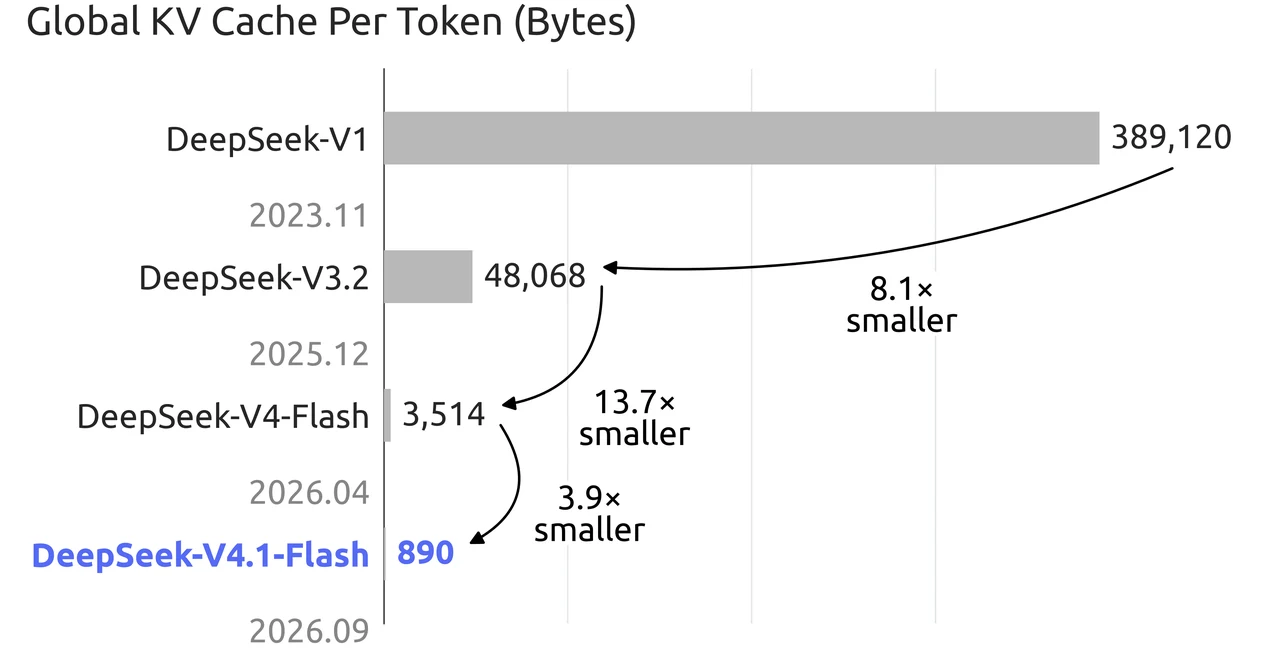
The number that matters to anyone running long-context models: the global KV cache dropped to 890 bytes per token, one quarter of V4-Flash’s 3,514 bytes and roughly 1/437th of DeepSeek-V1’s 389,120 bytes.
Three designs combine to get there: FP4 main KV caching (E2M1 format with one E4M3 scale per 16 channels), Compressed Sparse Attention 2 (CSA2), which assigns each attention layer one of three static modes (Full, Reindex, Reuse) to share KV and indexer state across layers, and SWA Bounded Replay, which reconstructs sliding-window KV states by replaying only the most recent tokens instead of persisting them to SSD, shrinking the persistent cache footprint to about one eighth of the previous generation.
Why should an end user care and not just a datacenter engineer? Because cache-hit charges make up a large share of agent costs, a compressed cache means cheaper hits, and it also means self-hosted deployments that are far less memory-hungry.
The Numbers: Where It Actually Leads and Trails
The official evaluation table (max reasoning effort) compares the model against Opus-5.0, GPT-5.6 Sol, Kimi-K3, GLM-5.3, and its two predecessors. The honest reading:
It leads the field on:
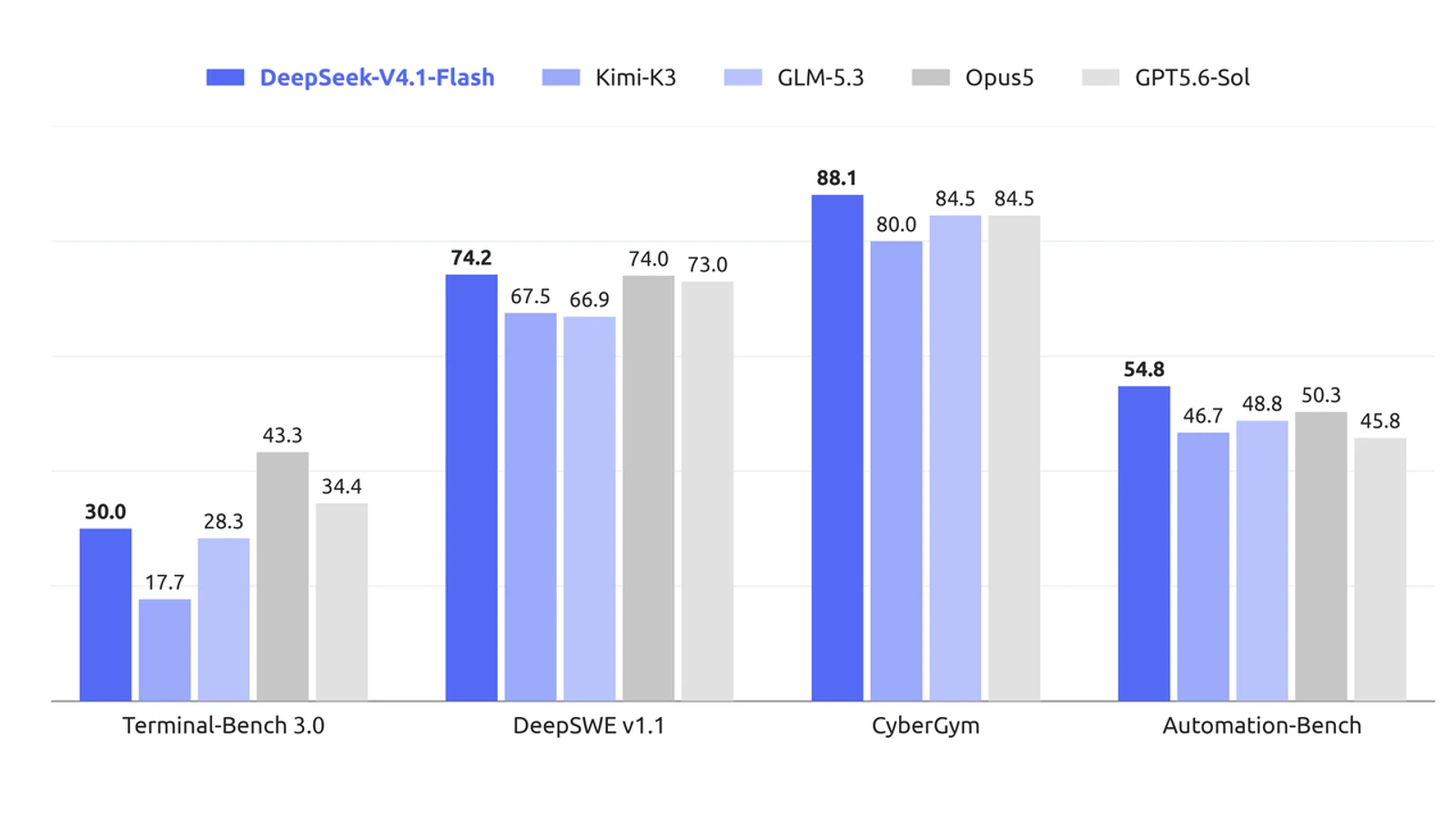
- Terminal-Bench 2.1: 90.6, the highest in the table, above Opus 5 (89.1) and GPT-5.6 Sol (88.8).
- DeepSWE v1.1: 74.2, edging out Opus 5 (74.0) and Sol (73.0).
- CyberGym: 88.1 versus 84.5 for Opus 5, Sol, and GLM-5.3.
- Automation-Bench: 54.8 versus 50.3 for Opus 5.
- Agent’s Last Exam: 31.8, the highest in the entire table.
- Codeforces: a 3471 rating, the highest listed among both open and closed models.
- GPQA Diamond: 90.9, close behind the leaders (Opus 93.4, Sol 94.1).
It trails on:
- HLE: 36.8 (39.1 on the text-only subset) versus 56.3 for Opus 5 and 44.5 for Sol. A clear gap on the hardest knowledge test.
- Terminal-Bench 3.0 and 4.0: 30.0 and 31.2 versus 43.3 and 51.8 for Opus 5. The newer Terminal-Bench generations separate the top tier, and this model sits in the second tier alongside Sol (34.4 and 39.9).
- Vision-with-tools tasks: Chartography 78.9, BabyVision 89.6, ZeroBench 49.0, all directly behind Opus 5 while generally ahead of the rest of the list.
The honest conclusion: this is a Flash-priced model that crosses into frontier territory on practical agentic benchmarks while staying behind on the deepest knowledge reasoning. DeepSeek published the full table unredacted, which is to its credit.
Pricing and the V4-Pro Sunset
The new pricing, per million tokens (peak / off-peak, with off-peak at half of peak):
- Input, cache hit: $0.006 / $0.003
- Input, cache miss: $0.30 / $0.15
- Output: $1.20 / $0.60
- Concurrency limit: 2,500 requests, versus 500 for V4-Pro
Peak hours are 01:00-04:00 and 06:00-10:00 UTC, Monday through Friday; all other hours are off-peak. For comparison, V4-Pro currently bills $1.32/$0.66 on cache-miss input and $3.96/$1.98 on output. The forced migration on September 14 therefore cuts a deepseek-v4-pro customer’s bill to roughly a quarter for input and output while, per DeepSeek’s own testing, improving performance, and the concurrency limit change from 500 to 2,500 is likewise in the customer’s favor.
Put these prices next to GLM-5.3-Flash, which we covered earlier at $0.075/$0.25, and you can see the budget-frontier war heating up from both directions: DeepSeek brings near-top capability at a lower price, and everyone else answers with near-zero pricing.
Open Weights and the Local-Deployment Reality
The weights are on Hugging Face under an explicit MIT license, with the full technical report, inference and weight-conversion guides inside the repo, and a stated commitment to work with the open-source community on inference support. There is also a telling line: “Planning a large-scale deployment with 2,000 GPUs + a storage cluster? Let’s talk.”
But local-run talk on the r/LocalLLaMA thread on day one was sober, not giddy. The model is 552 billion parameters, and on top of that sits an Engram memory of roughly 196 billion more. The community’s converged estimates: about 306 GB for the weights themselves (the MoE layers are natively FP4, so quantization saves you nothing), plus roughly 204 GB of Engram tables that can be streamed from disk at a latency cost. Practically: three DGX Spark units are the minimum, four make it comfortable, and anyone needing low time-to-first-token with the conditional memory in RAM wants around 500 GB. One commenter’s summary landed the point: their idea of “small” is a building full of GPUs.
And here is the sharpest critical note in the thread, worth quoting precisely: with quality at this level and prices this low, the economic case for running models locally collapses for most people. Local remains for those with privacy, control, or network-cost constraints, not for those chasing price.
First User Reports
The thread (50+ comments in the first hours) circles three subjects, all relevant to agent builders:
- Understanding the architecture. The highest-quality exchange concerned whether CED is an “encoder” in the traditional sense. Commenters who read the documentation corrected the first impression: this encoder is not bidirectional; the first half of the layers builds the core KV memory and the upper half reuses it, skipping roughly half the heavy computation. One commenter connected this to an old Microsoft paper finding that KV contents barely change past the middle layers. The takeaway for practitioners: expect context-processing speedups more than generation speedups.
- The size naming. A recurring observation that “Flash” no longer describes the size (the model is nearly double its predecessor), and that on paper its real budget-tier competitor is GLM-5.3-Flash at half the size, with the real-world gap between them still awaiting independent measurement.
- The ecosystem. vLLM recipes for four DGX Spark units appeared within hours, llama.cpp support is hoped for, and there is serious speculation about whether Qwen will adopt asymmetric activation and cache compression. The announced partnerships with OpenCode and WorkBuddy mean popular agents see the model from day one.
Mind the limits: these are launch-day impressions, not weeks-later reviews. There are no independent benchmark replications yet, and every number in the tables above comes from DeepSeek’s own evaluation framework, though the model card documents its setups in unusual detail and ships reproduction tooling.
What To Do Now
- On the API: switch your model name to
deepseek-flash. If you are ondeepseek-v4-flashordeepseek-v4-flash-vision-exp, you are already talking to V4.1-Flash; the old names are temporary. - On V4-Pro: the September 14 plan will cut your bill automatically but changes model behavior. Test sensitive workloads before the date, and pin the version in your settings if results are critical.
- On agent budgets: the smaller KV cache makes long-context agents structurally cheaper. Recost your pipelines with the new cache-hit price, and move flexible workloads off-peak (everything outside the peak windows listed above).
- On vision: support is native and no longer experimental. Document pages, diagrams, and dashboards go straight into the million-token context.
- On local deployment: count before you download: roughly 306 GB of weights plus a clear strategy for the Engram memory. Do not attempt it on less than three Spark-class machines or equivalent unified RAM.
Limits of What We Know
Every benchmark number above is DeepSeek’s own, documented with unusual care (max effort, temperature 1.0, per-benchmark harnesses), but vendor numbers until independently replicated. The model card enables step-by-step DeepSWE reproduction, which lowers the cost of verification for anyone willing. The HLE gap to Opus 5 is real and wide. Retiring V4-Pro before V4.1-Pro exists leaves a temporary hole at the top of the lineup that nothing yet fills. And forced routing between model names is convenient but blurs behavioral differences between generations: do not assume your old eval results on deepseek-v4-flash still hold.