The Claude Price Hike That Isn't: What Frontier API Pricing Actually Did in August 2026
If you budgeted for a 50% Claude price increase on September 1, you can stop. It is not happening, and Anthropic’s own documentation says so plainly.
That correction is worth making loudly, because the increase was widely reported as confirmed and the original deadline is three days away. Meanwhile the actual pricing news of August 2026 went in the other direction: OpenAI cut GPT-5.6 Sol by up to a third, and the pressure on cheap tokens is coming from somewhere else entirely.
What Happened
Three moves, three directions.
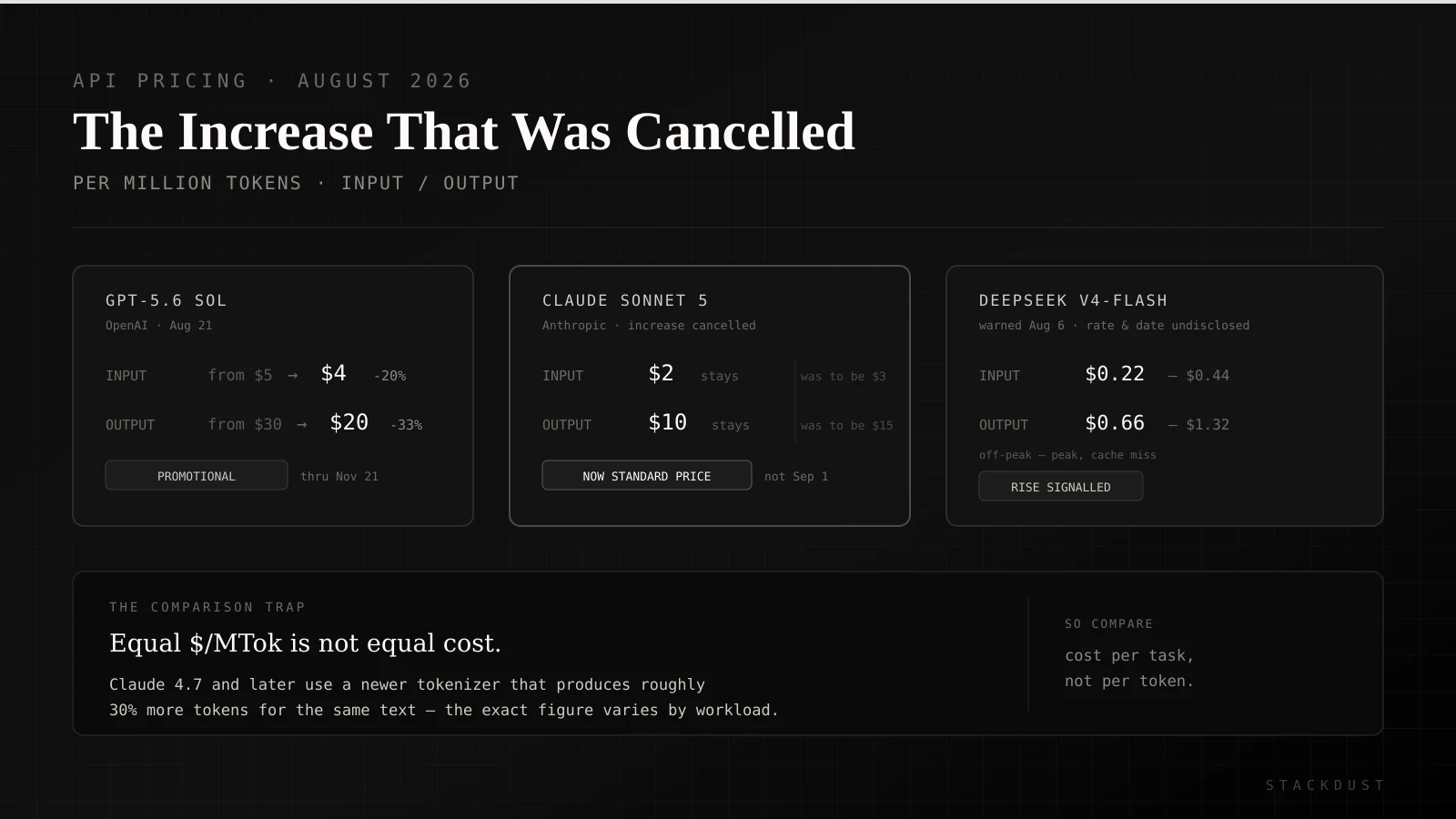
Anthropic cancelled a scheduled increase. Claude Sonnet 5 launched at $2/$10 per million input/output tokens, described at the time as introductory pricing running through August 31, 2026, after which it would rise to $3/$15. That rise is off. The pricing page now carries an explicit note:
The $2/$10 per million input/output token pricing for Claude Sonnet 5, announced at launch as introductory pricing through August 31, 2026, is now the standard price. The previously scheduled increase to $3/$15 per million input/output tokens on September 1, 2026 will not occur.
OpenAI cut prices. On August 21, 2026, GPT-5.6 Sol dropped from $5 to $4 per million input tokens and from $30 to $20 per million output tokens — 20% off input, 33% off output. The reduction applies to the API and is rolling out across eligible ChatGPT Work and Codex credits, and it extends to Fast mode, long-context requests, and Batch and Flex processing. Pro, Plus, and Business subscription usage is unchanged.
DeepSeek signalled the opposite. On August 6, 2026, DeepSeek warned developers of a significant coming increase without publishing a rate or a date.
Why It Matters
The reflex reading is “a price war.” The more useful reading is that the frontier and the floor have decoupled.
At the frontier, inference is getting cheaper per token, and vendors are competing on it openly. At the budget tier, the economics of selling tokens below cost have started to bite — DeepSeek’s own explanation points at demand outrunning available compute rather than at competitive positioning.
For anyone planning Q4 capacity, the practical consequence is that the cheapest line on a pricing table is now the least stable one.
What Things Actually Cost
Current published rates per million tokens:
| Model | Input | Cached input | Output |
|---|---|---|---|
| Claude Opus 5 | $5 | $0.50 | $25 |
| Claude Sonnet 5 | $2 | $0.20 | $10 |
| Claude Haiku 4.5 | $1 | $0.10 | $5 |
| GPT-5.6 Sol | $4 | $0.40 | $20 |
| GPT-5.6 Terra | $2 | $0.20 | $12 |
| GPT-5.6 Luna | $0.20 | $0.02 | $1.20 |
DeepSeek publishes peak and off-peak rates rather than a single number. V4-Flash currently lists $0.22–$0.44 per million input tokens on a cache miss and $0.66–$1.32 output, with off-peak rates at half the peak rate.
Batch processing halves Anthropic’s rates — Sonnet 5 runs $1/$5 in batch. Cache hits cost 10% of base input across the Claude line.
The Detail That Breaks Most Comparisons
Here is the part almost nobody accounts for. Sonnet 5 and GPT-5.6 Terra both list $2 per million input tokens. They do not cost the same.
From Anthropic’s pricing documentation:
Claude 4.7 and later models and Claude Mythos Preview use a newer tokenizer that contributes to their improved performance on a wide range of tasks. This tokenizer produces approximately 30% more tokens for the same text. The exact increase depends on the content and workload shape.
The same document, the same prompt, the same corpus produces meaningfully more billable tokens on current Claude models than it did on Sonnet 4.6 and earlier — and the comparison across vendors shifts accordingly. A headline rate of $2/MTok against another vendor’s $2/MTok is not a like-for-like number.
This cuts both ways and should not be read as a hidden markup: Anthropic states the tokenizer contributes to model performance, and a model that needs fewer output tokens or fewer retries to finish a task can still win on total cost. That is exactly the point.
Compare cost per completed task, not cost per token. Run your own workload through both, measure billed tokens on each side, and compare the invoice. Any other method is guessing.
What Developers Should Do
- Stop planning around the September 1 increase. If a spreadsheet, a runbook, or a vendor comparison has $3/$15 for Sonnet 5 after August 31, correct it.
- Note which prices are promotional. OpenAI’s Sol reduction is guaranteed through November 21, 2026. Anthropic’s $2/$10 is now the standard price with no stated end date. Those are different commitments — treat the first as a term, not a floor.
- Re-baseline before Q4. Prices moved in both directions this month; a model selection made in July may no longer be the cheapest option for your workload.
- Measure tokens, not rate cards. Log actual billed input and output tokens per task per model. The tokenizer difference makes this the only honest comparison.
- Build migration headroom at the budget tier. If you depend on DeepSeek’s economics, the warning was explicit even if the numbers were not. Keep the abstraction layer that lets you switch.
Limitations
Several things here are genuinely unsettled and should be treated that way.
DeepSeek has not published a rate or an effective date, and at the time of writing its pricing page carries no dated increase notice — only a general statement that prices may be adjusted. Any figure you see attributed to the coming increase is speculation.
OpenAI’s reduction is explicitly promotional and guaranteed only through November 21, 2026. What happens after that has not been announced.
Pricing pages also change without notice, and this article reflects what they said on August 28, 2026. For anything with money attached, check the vendor page rather than trusting a secondary source — including this one. That is precisely how the September 1 story went wrong.
For related context on what these models cost to run, see our coverage of OpenAI’s custom inference silicon, and for the budget-tier model at the centre of DeepSeek’s demand problem, V4-Flash-Vision-Exp.
Conclusion
The most widely repeated pricing fact this month — that Claude gets 50% more expensive on September 1 — is false, and it was checkable in one page of vendor documentation the whole time.
The real story is less dramatic and more useful: frontier inference got cheaper in August, cheap inference got less certain, and the token is a worse unit of comparison than most teams assume. Re-baseline before Q4 on your own numbers.