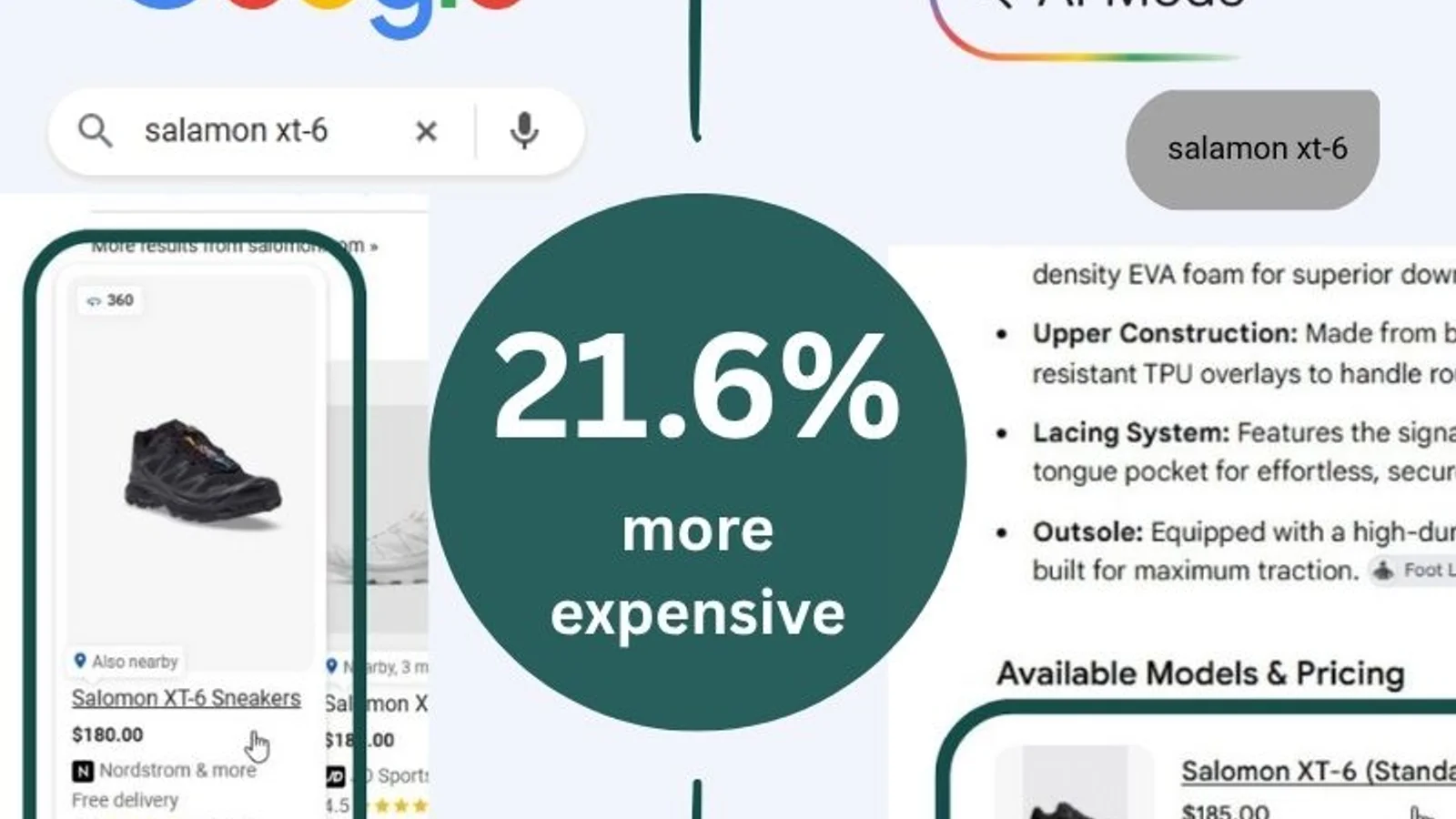
The AI Pricing Surcharge: Google AI Mode Displays Products 21.6% More Expensive Than Classic Search
The Algorithmic Surcharge: Tracking Two Million Listings Across Google AI Mode
Consumers turning to generative AI for commercial search operate under a clear premise: algorithmic assistants should eliminate the friction of opening dozens of browser tabs, comparing vendor margins, and hunting for deals. By synthesizing product reviews and interrogating Google’s Shopping Graph, an autonomous agent or conversational interface is expected to surface optimal purchase recommendations.
An exhaustive empirical study published on September 4, 2026 by search analytics platform Productrise reveals that Google AI Mode produces the exact opposite economic outcome. Over a 23-day observation window, researchers tracked more than 2,000,000 product listings across 100,000 search engine result pages (SERPs) and AI Mode responses.
The findings establish that when Google AI Mode and traditional Google Search respond to identical shopping queries on the same day, AI Mode displays lead offers that are on average 21.6 percent more expensive. AI Mode also swaps out the lead merchant on nearly half of all matched items, systematically suppressing the discounted, price-competitive listings that have anchored traditional search indexing for two decades.
Productrise Empirical Study Overview (23-Day Window)
| Metric | Measured Value |
|---|---|
| Total Product Listings Sampled | 2,000,000+ listings |
| Monitored Search Engine Pages | 100,000+ SERP & AI Mode pairs |
| Matched Products Price Difference | +21.6% average premium in AI Mode |
| Catalog Median Price | $149 (AI Mode) vs. $100 (Classic) |
| Catalog Overlap Between Surfaces | 1.28% shared ranking products |
| Lead Seller Mismatch Rate | 49.6% merchant substitution |
| Disagreement Skew | AI Mode higher 67% of the time |
Methodology: Isolating the Generative Pricing Gap
Comparing search surfaces requires rigorous controls to prevent spurious correlation caused by regional caching, dynamic currency adjustments, or shifting inventory stock. Productrise implemented a strict matching methodology:
- Direct Pair Matching: Headline price comparisons analyzed matched products only: the identical SKU, model identifier, and brand name queried on the identical calendar day.
- Lead Position Extraction: For each query, the audit captured the lead commercial placement (the lowest numerical rank position in classic search carousels versus the top-ranked visual entity in the AI Mode grid).
- Seller Normalization: The research tracked whether price differences stemmed from merchant repricing or whether Google’s retrieval pipeline substituted the merchant entirely.
- Outlier Quarantine: Outliers, such as pre-owned marketplace listings in classic search matched against brand-new retail inventory in AI Mode, were cataloged separately to isolate pure retail markup from condition variance.
Identical query dispatched to both search surfaces simultaneously (e.g., "Noise Cancelling Headphones").
- Ranking Priority: Lowest price filter and competitive direct price matching
- Data Feeds: Standard Merchant Center feeds, deal tags, and merchant promotional badges
- Ranking Priority: Rich structured metadata and direct checkout API capabilities
- Data Feeds: Shopping Graph entities and high-trust verified merchant records
Five Core Discoveries From the Dataset
The Productrise investigation yielded five structural insights into how Google’s generative shopping architecture operates:
1. The Matched Product Markup (+21.6%)
On direct SKU-for-SKU matches, the average price served to users inside AI Mode exceeded the traditional SERP lead offer by 21.6 percent. When examining the median difference across instances where AI Mode was more expensive, the gap sat at 22.2 percent.
2. Broad Catalog Divergence ($149 vs. $100)
Looking across all surfaced inventory rather than strict SKU pairs, AI Mode recommended substantially higher-tier goods. The median product price across the entire AI Mode catalog was $149, compared to $100 in traditional search, representing a 49 percent structural uplift. AI Mode curates an inherently smaller, higher-ticket subset of goods.
3. The Catalog Overlap Breakdown (1.28%)
Despite responding to identical commercial prompts, traditional search and AI Mode operate as disjoint ecosystems. Across the entire 23-day dataset, only 1.28 percent of products ranking in traditional search also surfaced in AI Mode. Users are not receiving a restructured view of Google’s search index; they are querying a distinct retrieval subsystem.
4. Asymmetric Disagreement Skew
When prices between the two surfaces disagreed, AI Mode was the pricier destination two-thirds (67%) of the time. Conversely, in the minority of cases where AI Mode was cheaper than traditional search, the median savings was a modest 7.8 percent. The algorithmic bias consistently penalizes budget-focused consumers.
5. Systematic Seller Swapping (49.6%)
In 49.6 percent of matched product instances, Google AI Mode selected a different merchant than traditional search. This finding is critical for retailers: AI Mode does not simply re-rank known merchant offers; it re-evaluates which merchant deserves the primary buy-box according to proprietary, non-price criteria.
- Classic Search Median: $100
- AI Mode Median: $149
- AI Mode More Expensive: 67% of cases (median markup: +22.2%)
- Classic Search More Expensive: 33% of cases (median savings: +7.8%)
Why Google’s AI Graph Prefers Higher-Priced Inventory
Why does an algorithmic search engine trained on customer intent prioritize more expensive goods? The disparity stems from architectural incentives inside Google’s Shopping Graph:
Feed Rigor and Merchant Trust Score
Traditional organic search often rewards scrapers, discount aggregators, and boutique merchants who submit raw product feeds with competitive price tags. However, AI Mode requires dense semantic grounding to generate conversational summaries. It favors enterprise merchants whose feeds supply complete JSON-LD schemas, real-time inventory webhooks, detailed return policies, and verified customer support endpoints. These enterprise retailers routinely charge higher baseline margins than discount clearance outlets.
Suppression of Secondary and Refurbished Goods
Classic search carousels frequently blend certified refurbished, open-box, or gray-market marketplace listings into top slots if the price is low. AI Mode’s reasoning prompts heavily penalize ambiguity: to avoid user complaints regarding product condition, the pipeline defaults to brand-new direct-from-manufacturer inventory.
Frictionless Conversational Checkout
As Google integrates instant checkout features directly into generative interfaces, the platform favors merchants integrated with Google Pay and direct API settlement. Retailers participating in turnkey checkout programs rarely compete on cut-rate pricing.
Strategic Implications for Consumers and E-Commerce Retailers
For shoppers, the findings demonstrate that generative search currently extracts a convenience tax. Users who rely on AI Mode to make rapid purchases surrender approximately one-fifth of their purchasing power compared to users who manually navigate classic organic listings.
For independent merchants and e-commerce operators, the study signals a paradigm shift. In classic search optimization, winning the organic carousel required competitive pricing and basic product feed hygiene. In AI Mode, price competitiveness is subordinated to metadata richness, schema completeness, and corporate entity verification. Brands that rely solely on aggressive discounting risk being rendered invisible as Google migrates search volume into generative interfaces.
As we analyzed in our breakdown of LLM operational costs in frontier API pricing models, AI systems introduce distinct economic trade-offs. In commercial search, convenience has replaced price transparency as the governing optimization metric.