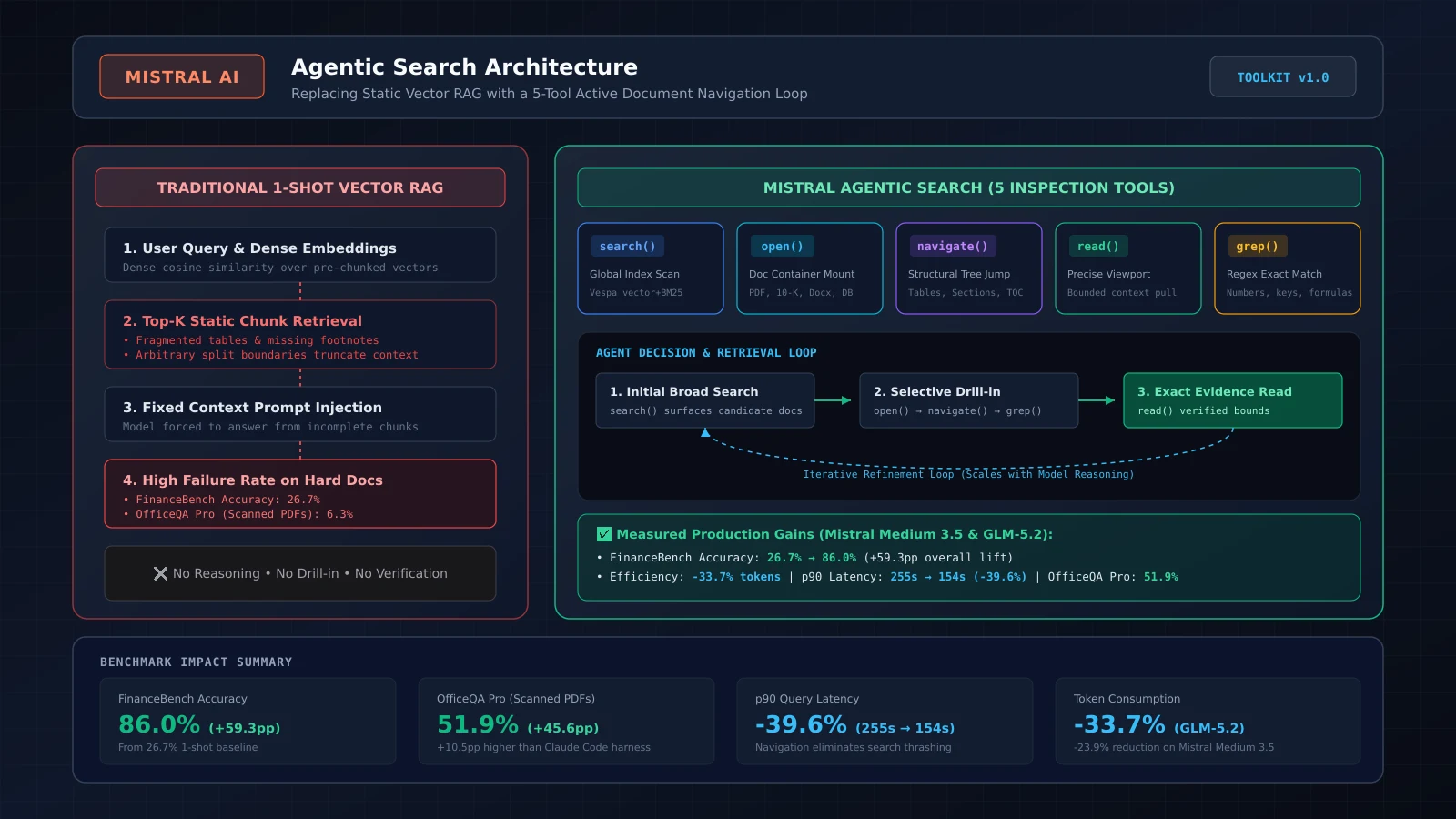
Mistral Agentic Search: Replacing Static Vector RAG with an Active 5-Tool Document Navigation Loop
Mistral AI has officially released Agentic Search and the open Mistral Search Toolkit, challenging the dominant paradigm of single-shot vector Retrieval-Augmented Generation (RAG). Instead of forcing language models to synthesize answers from static, top-$k$ vector chunks, Agentic Search equips models with an active five-tool inspection harness: search, open, navigate, read, and grep.
The architecture shifts document retrieval from a passive vector similarity lookup to an iterative, goal-driven file traversal loop. On rigorous enterprise evaluations, this loop lifts retrieval accuracy on FinanceBench from 26.7% to 86.0% (+59.3 percentage points), while reducing token consumption by up to 33.7% and cutting 90th-percentile (p90) query latency by 39.6%.
Why Naive 1-Shot RAG Fails on Enterprise Documents
For three years, standard RAG architectures have relied on a predictable pipeline: chunk a corpus into fixed token windows (e.g., 512 tokens), embed the chunks into dense vector spaces, run approximate nearest-neighbor (ANN) search for the top-$k$ matches, and stuff those raw chunks into the model context prompt.
While this approach works for isolated passages and FAQ lookups, it routinely collapses when deployed against complex, multi-page enterprise documents such as SEC 10-K filings, technical specifications, legal contracts, and scanned financial bulletins:
- Retrieval Without Reasoning: The model is forced to generate an answer exclusively from the static chunks selected in the initial retrieval step. If the initial search misses a critical footnote or retrieves an out-of-context sub-table, the model cannot pause, evaluate the missing information, or fetch the missing context.
- The Chunk-Level Boundary Problem: Tables, financial schedules, and nested clauses do not adhere to token boundaries. Splitting a 10-page financial statement across arbitrary 500-token chunks severs column headers from data cells, separates footnote markers from their explanatory text, and destroys document hierarchy.
- No Iterative Exploration or Verification: Questions like “What was the total nominal defense expenditure in calendar year 1953 across all monthly bulletins?” require identifying partial-year reporting periods, navigating to full-year reconciliations in subsequent quarterly reports, and aggregating data across disjoint documents. Single-shot vector RAG cannot execute this multi-hop reasoning.
User Query ➔ Dense Embedding ➔ Top-k Static Chunks ➔ Context Stuffing ➔ Risk of hallucination and sliced financial tables.
User Query ➔ search() ➔ open() ➔ navigate() ➔ grep() ➔ read() ➔ Continuous autonomous feedback loop until verified answer completion.
The 5 Inspection Primitives
Mistral’s Agentic Search replaces arbitrary chunk stuffing with five explicit, POSIX-inspired file-system inspection primitives. Rather than treating documents as flat bags of embeddings, the model interacts with the corpus as a structured file system:
| Tool | Signature | Operational Responsibility |
|---|---|---|
search | search(query: str, filters: dict) | Executes hybrid semantic (vector) and keyword (BM25) search across the corpus index to identify candidate documents. |
open | open(doc_id: str) | Mounts a specific document container (PDF, SEC filing, spreadsheet, or docx) and exposes its structural tree. |
navigate | navigate(doc_id: str, target: str) | Traverses the document’s table of contents, specific page ranges, table objects, or structural headings. |
read | read(doc_id: str, start_page: int, end_page: int) | Pulls contiguous, unfragmented text and table regions within verified structural bounds into the working memory. |
grep | grep(doc_id: str, pattern: str) | Runs exact regex or keyword pattern matching across the active document to pinpoint exact financial figures, dates, or IDs. |
Concrete Trajectory Comparison
Consider an inquiry requiring historical fiscal extraction from U.S. Treasury records:
- Without Agentic Search (1-Shot): The model issues
search("national defense expenditures monthly 1953"). The vector index returns 10 disjoint monthly bulletin fragments covering January through June 1953. Because it lacks tools to explore further, the model either halts or hallucinates the missing half of the calendar year. - With Agentic Search:
search("national defense expenditures monthly 1953")returns initial partial-year bulletins.- The model observes the temporal gap and issues a targeted search:
search("1953 November December 1954 to date"). - The index surfaces
treasury_bulletin_1954_02.pdf, page 15 (Table 3: complete 12-month calendar summary). - The model calls
read("treasury_bulletin_1954_02.pdf", page=15), ingests the verified table, and computes the exact total ($44,463M) with full structural provenance.
Empirical Benchmark Performance
Mistral evaluated Agentic Search on two demanding enterprise evaluation suites using out-of-the-box defaults (standard chunking, default ranking, zero fine-tuning) across Mistral Medium 3.5 and Z.ai GLM-5.2:
- 1-Shot Baseline RAG: 26.7%
- Search-Only Iterative Loop: 74.0% (+47.3pp)
- Full Agentic Search Harness: 86.0% (+59.3pp overall)
- 1-Shot Baseline RAG: 6.3%
- Claude Code Harness: 41.4%
- Mistral Agentic Harness: 51.9% (+45.6pp vs RAG, +10.5pp vs Claude)
1. FinanceBench (Islam et al., 2023)
FinanceBench evaluates financial question answering across 368 SEC filings (10-K, 10-Q, 8-K), averaging 147 pages per document (~53,900 total pages).
- Search-Only Loop vs. 1-Shot RAG: Simply wrapping search in an iterative loop lifted accuracy by +47.3pp for Mistral Medium 3.5 and +52.6pp for GLM-5.2 (~3x baseline).
- Adding Navigation Tools (
open,navigate,read,grep): Increased accuracy by an additional +8.7pp for Mistral Medium 3.5 and +6.7pp for GLM-5.2, bringing final accuracy to 86.0%.
2. OfficeQA Pro (696 Treasury Bulletins, ~89,000 Scanned PDF Pages)
OfficeQA Pro is a verifiable numeric benchmark testing mathematical reasoning over historical government finance records containing complex multi-column tables.
- One-shot RAG achieved only 6.3% accuracy due to table slicing.
- The full Agentic Search loop reached 51.9% on GLM-5.2 (+45.6pp) and improved Mistral Medium 3.5 by +27.1pp.
- When comparing harness implementations on identical weights (GLM-5.2), Mistral’s harness scored 51.9%, outperforming the Claude Code harness (41.4%) by +10.5pp.
Token Economics and Latency Dynamics
A common concern with agentic loops is that iterative tool calls exponentially increase token costs and execution latency. However, Mistral’s benchmark telemetry revealed the opposite effect:
- p90 Query Latency: 255s ➔ 154s (-39.6%)
- Mean Query Latency: 108s ➔ 71s (-34.3%)
- GLM-5.2 Token Usage: -33.7% reduction
- Mistral Medium 3.5: -23.9% reduction
- Eliminating Search Thrashing: When an agent lacks navigation tools, it attempts to solve missing context by issuing repetitive, broad keyword searches. Each broad search returns dozens of bulky candidate snippets, flooding the context window.
- Surgical Document Inspection: With
openandnavigate, the agent performs one broad search, identifies the target document, jumps directly to the relevant table, and reads only the exact viewport. This precision reduced token consumption by 33.7% on GLM-5.2 and 23.9% on Mistral Medium 3.5. - Latency Reductions: On FinanceBench, 90th-percentile (p90) query latency dropped from 255 seconds to 154 seconds (-39.6%), and mean latency dropped from 108 seconds to 71 seconds (-34.3%).
Architecture: Vespa Backend and the Search Toolkit
Mistral has exposed the Agentic Search infrastructure through the Mistral Search Toolkit and its open search-starter-app repository:
PDFs, SEC filings, financial spreadsheets, internal documentation, and databases.
OCR engines, LayoutLM visual parsing, and document hierarchy tokenizers.
- Dense vector embeddings for semantic retrieval
- BM25 inverted text indexes for exact matching
- Document hierarchy and page metadata schemas
search | open | navigate | read | grep
Autonomous task planning, verified multi-hop reasoning, and final structured response generation.
- Vespa Hybrid Backend: The default deployment leverages Vespa for distributed indexing, combining dense semantic embeddings with BM25 inverted text indexes and structured schema filtering.
- Model Agnosticism: The 5-tool harness requires no fine-tuning or proprietary model weights. Because the primitives map to standard tool calling (function calling), the system works equally well with Mistral Medium, open-weight models, or external reasoning engines. As model reasoning improves, search accuracy scales automatically without altering the indexing pipeline.
- Integration Points: Developers can access Agentic Search directly via the Mistral Search Toolkit SDK for custom enterprise deployments, or use pre-configured instances inside Mistral Studio and Mistral Vibe.
Implementation: Building an Agentic Retrieval Loop
Integrating Agentic Search using the Mistral SDK follows standard tool-dispatch patterns. Below is an end-to-end Python implementation configuring the five tools:
import os
from mistralai import Mistral

client = Mistral(api_key=os.getenv("MISTRAL_API_KEY"))

# Define the 5 Agentic Search tool primitives
tools = [
    {
        "type": "function",
        "function": {
            "name": "search",
            "description": "Search the index across all documents for relevant passages.",
            "parameters": {
                "type": "object",
                "properties": {
                    "query": {"type": "string", "description": "Search query keywords or semantic phrasing"},
                    "filter_year": {"type": "integer", "description": "Optional fiscal year filter"}
                },
                "required": ["query"]
            }
        }
    },
    {
        "type": "function",
        "function": {
            "name": "open_doc",
            "description": "Open a document container and inspect its structural hierarchy.",
            "parameters": {
                "type": "object",
                "properties": {
                    "doc_id": {"type": "string", "description": "Unique document identifier"}
                },
                "required": ["doc_id"]
            }
        }
    },
    {
        "type": "function",
        "function": {
            "name": "navigate_section",
            "description": "Navigate to a specific section, table, or page range.",
            "parameters": {
                "type": "object",
                "properties": {
                    "doc_id": {"type": "string"},
                    "section_title": {"type": "string"}
                },
                "required": ["doc_id", "section_title"]
            }
        }
    },
    {
        "type": "function",
        "function": {
            "name": "read_viewport",
            "description": "Read exact text and table contents within specified bounds.",
            "parameters": {
                "type": "object",
                "properties": {
                    "doc_id": {"type": "string"},
                    "start_page": {"type": "integer"},
                    "end_page": {"type": "integer"}
                },
                "required": ["doc_id", "start_page", "end_page"]
            }
        }
    },
    {
        "type": "function",
        "function": {
            "name": "grep_pattern",
            "description": "Execute regex or exact keyword matching within an open document.",
            "parameters": {
                "type": "object",
                "properties": {
                    "doc_id": {"type": "string"},
                    "pattern": {"type": "string"}
                },
                "required": ["doc_id", "pattern"]
            }
        }
    }
]

# Execute the agentic loop with mistral-medium
messages = [
    {
        "role": "user",
        "content": "Verify Apple's Q3 effective tax rate from the latest 10-Q filing and cite the exact footnote."
    }
]

response = client.chat.complete(
    model="mistral-medium-latest",
    messages=messages,
    tools=tools,
    tool_choice="auto"
)

print(response.choices[0].message)
When to Use Agentic Search vs. Standard Vector RAG
While Agentic Search establishes a new state-of-the-art for complex documents, it is not a universal replacement for all search workloads:
| Scenario / Workload | Recommended Architecture | Architectural Rationale |
|---|---|---|
| Simple FAQs / Short Articles | Standard 1-Shot RAG | Low latency requirement (<300ms); the target answer is fully contained in a single chunk. |
| High-Volume Search Autocomplete | Inverted BM25 / Vector ANN | Query volume exceeds 1,000 QPS where multi-turn agent loops are cost-prohibitive. |
| SEC Filings, 10-K & 10-Q Audits | Agentic Search | Multi-table cross-referencing, footnotes, and accounting reconciliations require iterative verification. |
| Complex Legal Contracts & Leases | Agentic Search | Clause dependencies, definitions sections, and rider cross-references break static chunking. |
| Scanned Engineering Manuals / PDFs | Agentic Search | OCR table layouts and multi-column schematics require targeted visual/structural viewport reads. |
Industry Implications: The Death of Naive Chunking
Mistral’s release formalizes a critical inflection point in LLM application engineering: retrieval quality is no longer bounded by chunking algorithms, but by agent reasoning capacity.
For years, developers attempted to fix RAG failures through increasingly convoluted chunking heuristics—parent-child chunking, sliding windows, and hypothetical document embeddings (HyDE). Agentic Search demonstrates that treating retrieval as an active tool-use problem renders static chunk tuning obsolete.
As enterprise teams move from prototypes to mission-critical automation in finance, legal, and engineering, active navigation harnesses will become the baseline standard for document intelligence.
Related Coverage
- MCP Stateless Protocol Specification & Maintainer Roadmap
- Anthropic Claude Agent Stack GA: Computer Use, Skills API, and Files API
- OpenAI June 2026 Deprecations Migration Guide: Moving to Agents SDK
- Qwen3.8-Flash-Next Architecture Deep Dive