Qwen3.8-Flash-Next: Alibaba Opens the Architecture Behind Qwen4
Alibaba’s Qwen team has released Qwen3.8-Flash-Next, an open-weight model whose purpose is unusual for a flagship-adjacent drop: it exists mainly to show its own architecture. Rather than a routine version bump, Qwen3.8-Flash-Next is explicitly framed as an experimental preview of the design that will underpin Qwen4 — and the team has published the full 125B-parameter weights on Hugging Face for anyone to inspect, run, or fine-tune.
What Happened
Qwen published Qwen3.8-Flash-Next on August 26, 2026, alongside a technical report and open weights on Hugging Face and ModelScope, under the qwen-community-1.0 license. In the same announcement, Qwen’s official account confirmed a related but distinct product: Qwen3.8-Flash, a production build “based on Qwen3.8-Flash-Next with more production features” — a larger default 1M-token context and built-in tool support — that will ship as a managed model on QwenCloud at $0.16 per million input tokens and $0.47 per million output tokens.
These are two different release states, and conflating them would misrepresent what’s actually available today:
- Qwen3.8-Flash-Next — open weights, released now, downloadable and self-hostable.
- Qwen3.8-Flash — the production API variant — announced with pricing, not yet live. Qwen’s own post says the QwenCloud endpoint “will be available soon.”
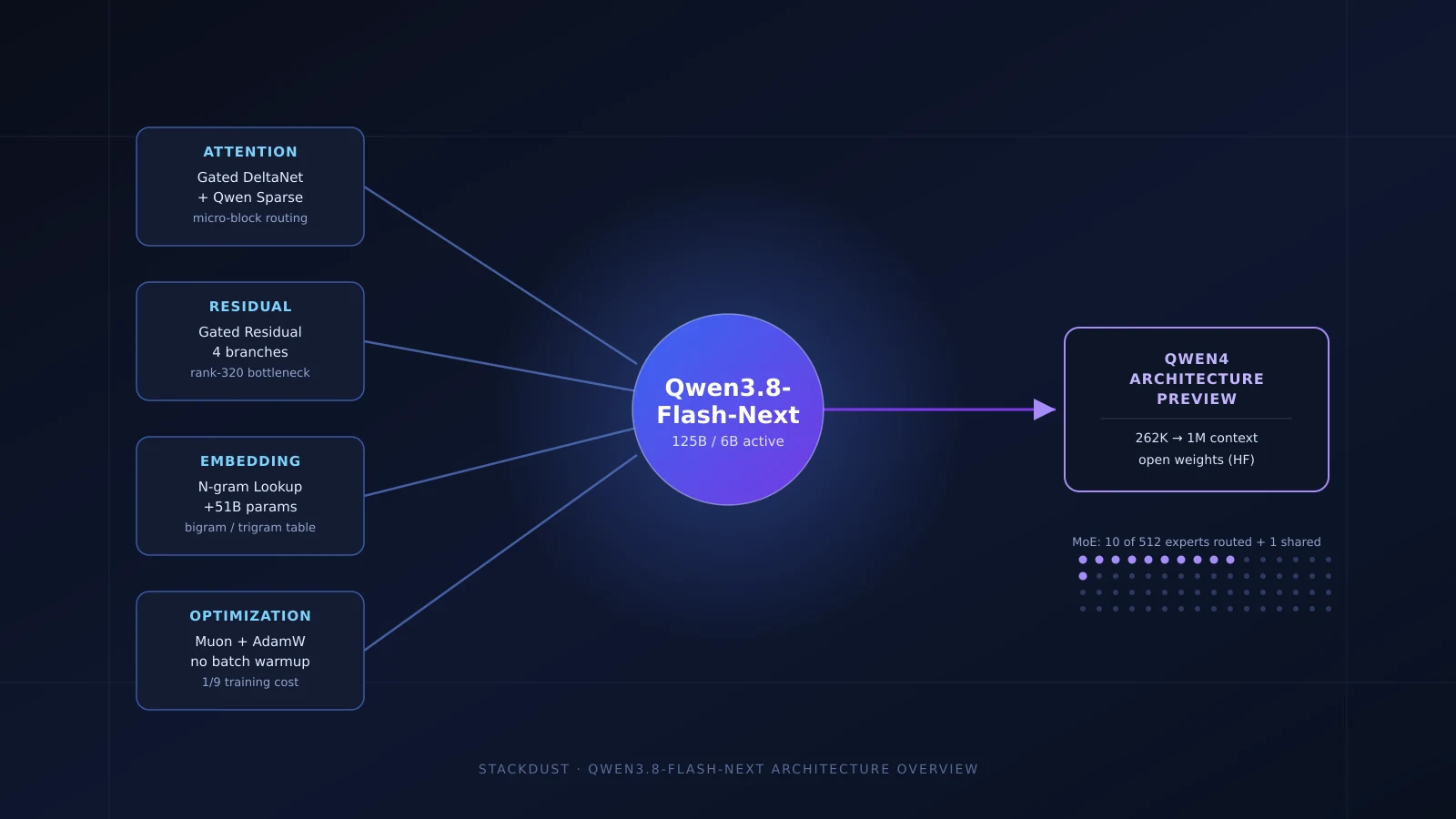
The model card is explicit about the research framing: this release “upgrades systematically along four aspects — attention, residual, embedding, and optimization — improving model capability while further optimizing computational efficiency, model capacity, and training stability.” Reading it as a Qwen4 architecture preview, not a finished commercial product, is the correct frame.
Why It Matters
It’s a MoE model with a genuinely small active footprint. Qwen3.8-Flash-Next carries 125B total parameters but activates only 6B per token — plus a separate 51B-parameter N-gram embedding table and a 4B multi-token-prediction module used during training. For self-hosters, active-parameter count is what determines inference cost and hardware footprint, not the headline total.
It was dramatically cheaper to train. Qwen states the model took roughly 1/9 the training compute of Qwen3.7-Plus while outperforming it on coding and office-productivity tasks — a claim about training efficiency, not inference cost, but a meaningful one if it holds up under independent scrutiny.
The architecture is a legitimate departure, not a naming refresh. Four subsystems were rebuilt from the previous Qwen3 generation, described below, and Qwen is positioning all four as the template for Qwen4 rather than a one-off experiment.
Architecture Deep Dive: Four Rebuilt Subsystems
1. Attention — Gated DeltaNet + Qwen Sparse Attention (QSA)
The model replaces standard attention with a hybrid: Gated DeltaNet (GDN), a linear-attention mechanism that compresses history efficiently (48 linear heads for V, 16 for QK, 128-dim heads), paired with Qwen Sparse Attention (QSA) — 24 query heads, 2 KV heads, 256-dim heads — that uses a compressed, lightweight indexer to select relevant context. The key design choice: QSA operates at micro-block granularity rather than scoring individual tokens, which cuts the routing overhead that token-level sparse attention schemes typically pay. Rotary position embeddings run at 64 dimensions across 48 transformer layers.
2. Residual — Gated Residual (GR)
A four-branch gated residual connection with a 320-dimension bottleneck rank replaces the standard residual stream, intended to give the network finer-grained control over how information flows between layers.
3. Embedding — N-gram lookup
A 51B-parameter table indexes bigrams and trigrams at layer 2, scaling model capacity for very little extra compute — parameters that sit outside the active 6B and outside the routed MoE experts, but that contribute to representational capacity on every forward pass.
4. Optimization — Muon + AdamW, no batch-size warmup
Training splits weight categories between the Muon and AdamW optimizers, refined around orthogonalization accuracy and how fused parameters are divided between the two. Qwen also eliminated the traditional batch-size warmup phase, starting directly at the target batch size — a change the team attributes to “refitted scaling laws” derived from this training run.
Underneath these four pillars sits a 512-expert MoE, routing 10 experts plus 1 shared expert per token (640-dim expert intermediate size) — the mechanism that keeps 6B of the 125B total parameters active on any given forward pass.
Context Length and a Real Caveat
Qwen3.8-Flash-Next ships with a native context of 262,144 tokens, extensible to 1,000,000 tokens via YaRN RoPE scaling. The model card flags a genuine trade-off here: the YaRN scaling is static, which can hurt performance on shorter texts relative to a model tuned specifically for that length. If your workload is mostly short-context, that’s worth benchmarking before assuming the long-context number is free.
Benchmarks — Read as Self-Reported
Qwen’s technical report lists, among others: DeepSWE 1.1 at 58.7, SWE-bench Pro at 62.5, GPQA Diamond at 91.7, and LiveCodeBench v6 at 91.9 on the language side; ClawEval-MM at 64.4 pass@3, AndroidWorld at 84.5, and MathVision between 90.6 and 95.7 (with and without chain-of-thought) on the multimodal side. These are Qwen’s own evaluation numbers, run under Qwen’s own harness settings — treat them the way any vendor benchmark deserves to be treated: directionally informative, not independently verified. As with GLM-5.3-Flash’s release and DeepSeek’s vision model, the open weights mean the community can and likely will re-run these independently within days.
How to Try It
The weights are already supported across the major self-hosting stacks: SGLang, vLLM, Hugging Face Transformers, llama.cpp, MLX, and Unsloth, with quantized builds (including NVFP4 and GGUF) already appearing from the community. Given the 125B total parameter count, running the full model still requires multi-GPU or high-memory hardware even though only 6B parameters activate per token — the N-gram table and idle experts still have to live somewhere in memory or be paged efficiently by your serving stack.
For managed inference without self-hosting, the announced path is the QwenCloud API once Qwen3.8-Flash goes live, at the stated $0.16/$0.47 per-million-token rate — worth comparing against the API pricing landscape covered in our frontier pricing roundup once that endpoint actually opens.
Limitations
- Benchmarks are vendor-reported. No independent evaluation has landed yet at time of publication.
- Static YaRN scaling trades away some short-context quality for the 1M-token extension.
- Thinking mode is on by default, which adds latency and token cost to every response unless explicitly disabled.
- The production API isn’t live yet. The $0.16/$0.47 pricing is announced, not something you can currently transact against.
- License is qwen-community-1.0, not a permissive OSI license like MIT or Apache — check its terms against your use case before deploying commercially, especially at scale.
What Developers Should Do
If you’re tracking where Alibaba’s model architecture is heading, this release is the clearest signal available before Qwen4 itself ships — read the technical report, not just the parameter counts. If you’re evaluating it for actual deployment, self-host the open weights on your own workload before committing budget to the still-unreleased API tier, and treat the 1/9-training-cost and benchmark claims as hypotheses to test rather than settled facts.