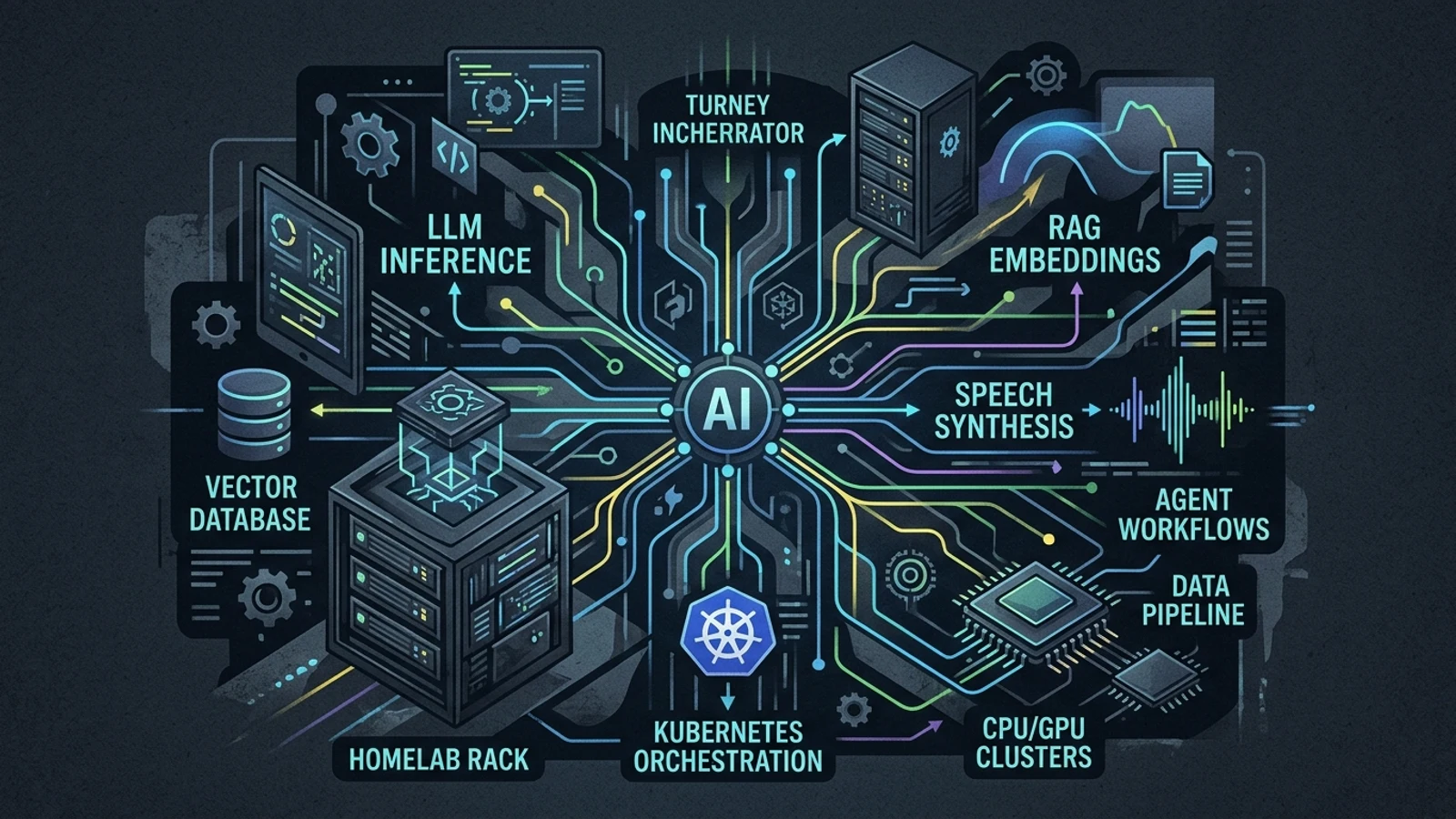
ODS: Turnkey Local AI Server for LLM Inference, RAG, Voice & Agents
The Homelab AI Appliance: Unified Inference, RAG, and Autonomous Agents
Building a robust local AI lab traditionally requires stitching together disparate software components: running Ollama or vLLM for inference, deploying ChromaDB or Qdrant for vector storage, spinning up Open WebUI for client chat, configuring Whisper for speech-to-text, and wiring up custom Python scripts for agent tool execution. ODS (Open Data Server) streamlines this fractured ecosystem into a cohesive, turnkey AI appliance.
Published under the Apache-2.0 license, ODS transforms any Linux workstation, macOS workstation, or homelab server into an enterprise-ready private AI hub capable of handling model execution, document semantic search (RAG), voice pipelines, and multi-step agent workflows from a single control plane.
What It Is
ODS is an open-source local AI orchestration server and management interface. It abstracts the underlying compute layer, providing an integrated environment where developers can download and execute open-weight models, ingest proprietary document libraries, and construct automated agent pipelines without manual configuration glue.
The system features an intuitive web UI, an OpenAI-compatible API gateway, native GPU resource scheduling (CUDA, Metal, ROCm), and a zero-configuration retrieval-augmented generation (RAG) pipeline supporting PDF, Office, and Markdown files.
Why You Have Not Heard Of It
Developed by Osmantic to eliminate the friction of configuring local AI stacks, ODS was architected for engineering teams and homelab operators who demand an integrated appliance experience rather than managing five separate Docker containers. Its rapid rise on GitHub reflects widespread developer demand for consolidated local AI infrastructure.
How It Works
ODS coordinates internal subsystems through a unified service bus:
- Hardware-Accelerated Inference Core: Dispatches tensor operations to NVIDIA CUDA, Apple Metal, or AMD ROCm runtimes, supporting dynamic quantization and context window allocation.
- Integrated RAG Vector Engine: Automatically parses, chunks, and embeds uploaded documents into an embedded high-speed vector index with hybrid dense/sparse retrieval.
- Sandboxed Agent Execution Runtime: Empowers local models with tool-calling capabilities, allowing agents to execute bash scripts, perform internal network lookups, and orchestrate automated workflows securely.
Running It
ODS is deployed as a consolidated Docker Compose stack with GPU acceleration:
services:
  ods-server:
    image: osmantic/ods:latest
    container_name: ods-server
    restart: unless-stopped
    ports:
      - "5000:5000"
    volumes:
      - ./models:/app/models
      - ./data:/app/data
      - ./documents:/app/documents
    deploy:
      resources:
        reservations:
          devices:
            - driver: nvidia
              count: all
              capabilities: [gpu]
    environment:
      - TZ=UTC
Start the service:
docker compose up -dNavigate to http://localhost:5000 to access the master dashboard, pull models, and configure document knowledge bases.
What It Replaces
- Fragmented Container Stacks: Replaces the maintenance overhead of juggling Ollama, ChromaDB, Whisper, and Open WebUI independently.
- Commercial Cloud RAG SaaS: Enables secure, offline document indexing and semantic search without leaking proprietary PDFs to external APIs.
- Complex Agent Frameworks: Provides built-in visual workflow builders and sandboxed tool-calling environments out of the box.
Limitations
Because it packages an entire local AI ecosystem, ODS benefits from robust hardware. While basic CPU inference is supported, optimal performance for simultaneous RAG indexing and LLM generation requires at least 16–32 GB of system RAM and a dedicated GPU.
Who It Is For
- Homelab operators seeking a turn-key private AI hub for home automation and personal knowledge bases.
- Engineering teams requiring an air-gapped internal AI API and document search appliance.
- Developers prototyping multi-modal agent workflows without external cloud dependencies.
Conclusion
ODS represents the natural maturation of the self-hosted AI ecosystem: moving from fragmented tools toward unified, reliable appliance platforms. For anyone seeking to maximize their local compute hardware, ODS is a powerful solution.