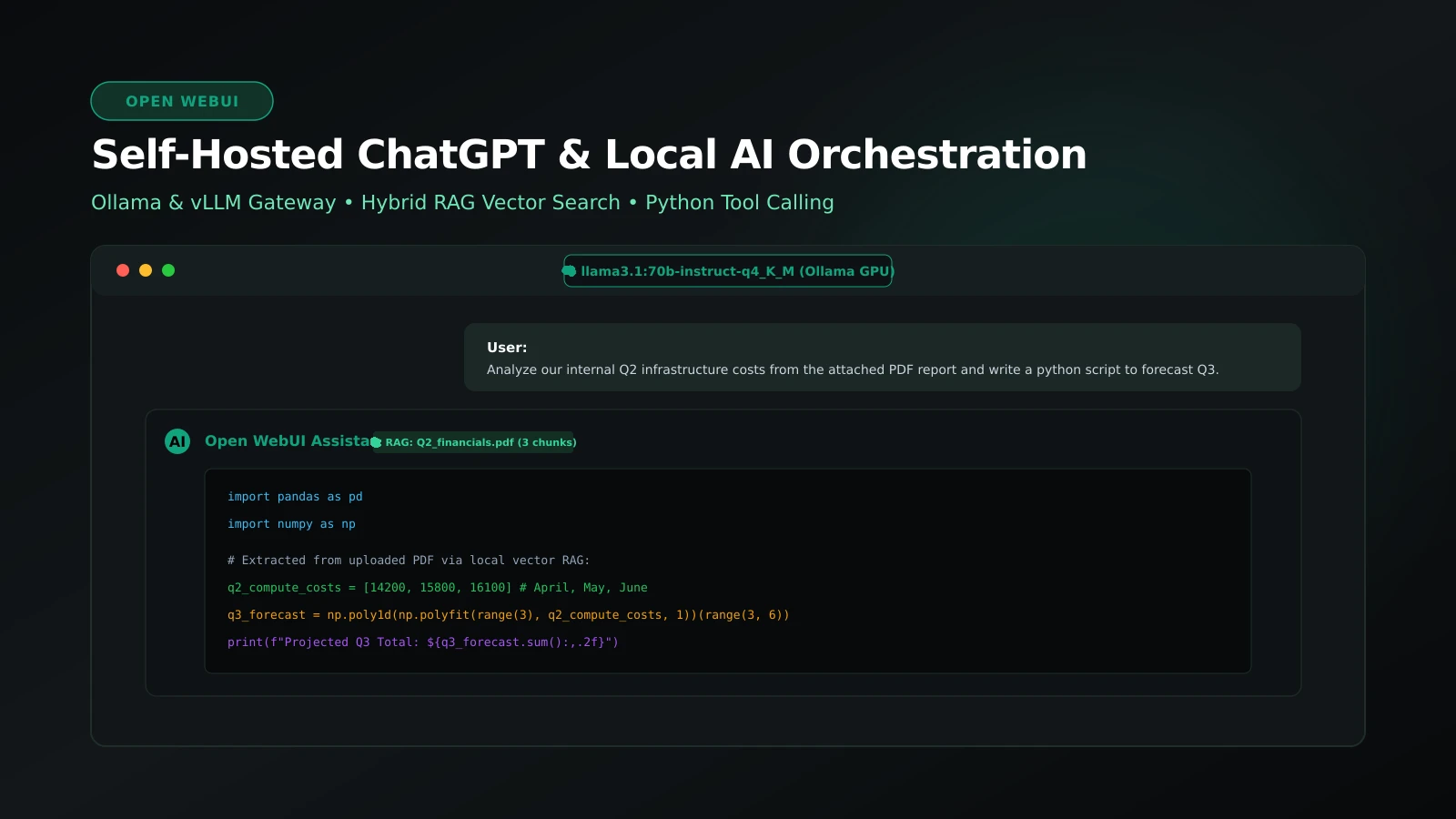
Open WebUI: The Complete Self-Hosted Local AI, RAG & Agent Orchestration Guide
Sovereign Artificial Intelligence: Building a Private ChatGPT Appliance with Open WebUI
Commercial conversational AI platforms like ChatGPT, Claude, and Gemini have redefined knowledge work. However, transmitting proprietary source code, legal agreements, and corporate data to external cloud vendors introduces critical confidentiality risks. Open WebUI provides the production-grade open-source solution: a private, self-hosted AI control plane running 100% locally within your infrastructure.
Far more than a simple chat wrapper, Open WebUI is a comprehensive AI orchestration platform. It unifies local inference backends (Ollama, vLLM) and commercial APIs under an intuitive interface featuring document retrieval-augmented generation (RAG), live web grounding, interactive code execution, voice pipelines, and granular multi-user role-based access control (RBAC).
What It Is
Open WebUI is a modern, open-source (MIT) web application and backend gateway designed for local AI interaction. It delivers a fluid user experience mirroring commercial platforms, complete with code artifact rendering, two-way conversational voice (Whisper + TTS), custom prompt presets, and customizable Modelfiles.
Its built-in RAG engine automatically chunks and embeds uploaded PDFs and text files into an embedded vector database (ChromaDB), allowing users to interrogate documents semantically with zero external API calls.
Why You Have Not Heard Of It
Surpassing 80,000 stars on GitHub, Open WebUI has become the definitive UI standard for local LLMs and Ollama clusters. It is widely adopted by enterprise engineering teams, academic research labs, and privacy-conscious homelab operators.
How It Works
Open WebUI coordinates complex AI pipelines through a modular architecture:
- Inference Gateway: Dispatches requests to local Ollama endpoints or vLLM clusters with dynamic parameter overrides and real-time streaming tokens.
- Hybrid RAG Pipeline: Ingests and vectorizes documents locally, combining BM25 keyword matching with dense vector retrieval for high-accuracy contextual recall.
- Pipelines & Tool Engine: Executes custom Python scripts for guardrails, web scraping (via SearXNG or Brave Search), and automated tool calling.
Step-by-Step Deployment Guide
Deploying Open WebUI alongside Ollama with NVIDIA GPU acceleration via Docker Compose:
services:
  ollama:
    image: ollama/ollama:latest
    container_name: ollama
    restart: unless-stopped
    ports:
      - "11434:11434"
    volumes:
      - ./ollama_data:/root/.ollama
    deploy:
      resources:
        reservations:
          devices:
            - driver: nvidia
              count: all
              capabilities: [gpu]

  open-webui:
    image: ghcr.io/open-webui/open-webui:main
    container_name: open-webui
    restart: unless-stopped
    ports:
      - "3000:8080"
    environment:
      - OLLAMA_BASE_URL=http://ollama:11434
      - WEBUI_SECRET_KEY=generate_a_very_long_secret_key_here
      - DEFAULT_MODELS=llama3.1:8b
    volumes:
      - ./open-webui_data:/app/backend/data
    depends_on:
      - ollama
Start the service:
docker compose up -dNavigate to http://<SERVER_IP>:3000 to register the master administrator account, pull your desired open-weight models (such as Llama 3.1 or DeepSeek-Coder), and begin interacting with your private AI infrastructure.
What It Replaces
- Commercial ChatGPT Team Subscriptions: Eliminates recurring per-seat SaaS costs while keeping internal company data secure.
- Proprietary Document RAG SaaS: Enables secure, air-gapped document Q&A over internal technical documentation and PDFs.
- Primitive Terminal CLI Interfaces: Provides a rich, collaborative UI for all team members regardless of technical background.
Limitations
Generation speed and context window capacity depend on the host server’s GPU VRAM (recommended: 8–16 GB VRAM minimum for 8B–14B models).
Who It Is For
- Engineering organizations requiring an air-gapped AI workspace for proprietary codebases.
- Homelab operators seeking a centralized AI service for household users.
- AI researchers experimenting with open-weight model architectures and custom tool pipelines.
Conclusion
Open WebUI represents the pinnacle of self-hosted AI software. By combining aesthetic elegance with enterprise-grade capabilities, it gives you absolute ownership over the future of artificial intelligence.