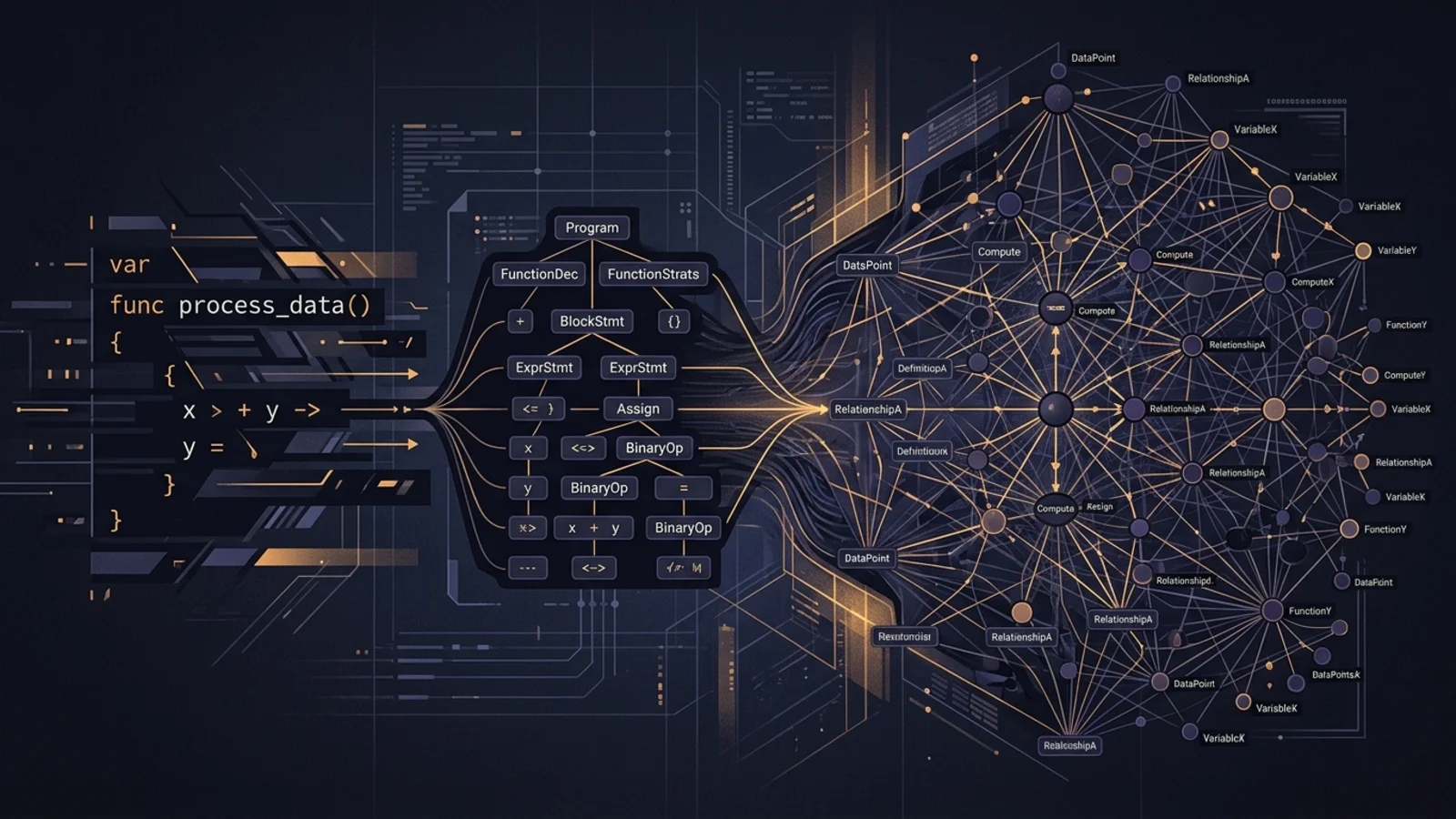
Graphify v0.9.55: Replacing Vector RAG with Deterministic AST Knowledge Graphs for Coding Agents
Code Intelligence Without Hallucinations: How Deterministic AST Graphs Outperform Vector RAG
Autonomous coding assistants face a fundamental structural limitation when navigating repositories: vector search does not understand code syntax. When an agent searches for callers of a function, inheritance hierarchies, or database mutation paths, standard retrieval-augmented generation (RAG) splits files into arbitrary character chunks, computes cosine similarity over text embeddings, and returns approximate paragraphs. This approach frequently retrieves documentation mentioning a symbol while missing the actual implementation three call hops away.
With the release of version 0.9.55 on September 5, 2026, Graphify (developed by Graphify-Labs under an Apache 2.0 license and holding more than 115,000 GitHub stars) delivers a deterministic alternative. Instead of converting source code into vector approximations, Graphify parses repositories into deterministic Abstract Syntax Tree (AST) knowledge graphs, mapping relationships directly into an index that autonomous agents query through the Model Context Protocol (MCP).
Why Vector RAG Breaks Down in Software Engineering
The failure of standard vector RAG in agentic software engineering stems from three architectural mismatches:
- Syntactic Precision vs. Lexical Proximity: Vector embeddings evaluate semantic meaning in natural language. In software code, variable names, interfaces, and type signatures require exact reference resolution. A function named
handleAuthin a billing module has high vector similarity tohandleAuthin an administrative gateway, leading vector stores to return the wrong module. - The Multi-Hop Blind Spot: Answering a question such as “If I change this schema column, which API endpoints break?” requires traversing a directed chain: Table Schema -> ORM Model -> Repository Layer -> Controller -> API Route. Vector search returns disjointed fragments and expects the LLM to hallucinate the intermediate links within its context window.
- Context Window Inflation: Naive RAG fills agent context with full-text chunks, inflating token consumption and degrading agent reasoning performance across extended debugging sessions.
Source Code ➔ Arbitrary Chunks ➔ Text Embeddings ➔ Vector DB ➔ Approximate Matches.
- High token consumption flooding context windows with unneeded boilerplate
- Inability to trace multi-hop call chains and cross-file relationships
Source Code ➔ Tree-Sitter AST ➔ Symbol Extractor ➔ Directed Graph ➔ Native MCP Tools.
- Exact source line references and deterministic symbol boundaries
- Multi-hop determinism across dependencies without guesswork
How Graphify Works
Graphify operates as a local engine and Model Context Protocol server. It constructs its graph without issuing calls to external LLM inference endpoints during index construction, preserving confidentiality and eliminating indexing latency.
1. Deterministic Multi-Language AST Extraction
Graphify uses Tree-Sitter parsers to analyze code across TypeScript, JavaScript, Python, Go, Rust, Java, C++, and SQL schemas. The parser generates two primary data primitives:
- Typed Nodes: Files, Functions, Methods, Classes, Interfaces, Enums, Database Schemas, API Endpoints, and Configuration Blocks.
- Typed Directed Edges:
calls,inherits,implements,imports,defines,reads, andmutates.
Each edge stores exact source file paths and byte offsets. If function processInvoice calls chargeCard on line 142 of billing.ts, the edge is a mathematical pointer rather than an embedding probability.
2. Semantic Document and Spec Linking
Beyond code syntax, Graphify parses Markdown documentation, OpenAPI specifications, and SQL migration files. When an architecture guide refers to an entity, Graphify links the document node to the corresponding code symbol node using conservative provenance guards, ensuring conceptual documentation connects directly to executable code.
3. Native Model Context Protocol (MCP) Interface
Graphify exposes its graph engine as an MCP server over standard input/output (stdio) and HTTP Server-Sent Events (SSE). Agents connecting via Claude Code, Cursor, Codex, or the Gemini CLI gain access to four deterministic tools:
graphify_get_callers: Returns all direct and indirect callers of a specified symbol up to a defined depth.graphify_trace_flow: Traces data flow from an input parameter through transformations to a terminal sink (such as a database query or network dispatch).graphify_impact_analysis: Identifies all modules, tests, and configuration nodes affected by a proposed modification to an interface.graphify_explain_edge: Returns the exact code lines that justify a structural relationship between two nodes.
What Shipped in v0.9.55
The September 5, 2026 release of version 0.9.55 addresses several critical edge cases in real-world TypeScript and Python codebases:
1. Barrel Re-Export Resolution (#3358)
Modern JavaScript and TypeScript libraries frequently organize exports through barrel files (index.ts) using re-export patterns such as export { Client } from './client' or export * from './types'. Previously, Graphify created intermediate nodes for the barrel file, which sometimes left relationships dangling when resolving deeply nested exports. Version 0.9.55 traces named re-exports directly back to their originating definitions, collapsing barrel indirection while keeping graph traversal deterministic.
2. TypeScript Dynamic Import Preservation (#3210)
Runtime dynamic imports using import('./module') inside type arguments were previously rewritten or blanked by the syntax normalizer during error-recovery passes. The new release parses dynamic imports within type arguments accurately, preserving lazy-loaded module dependencies in the resulting graph.
3. Underscore Member Collision Fix in Python (#3302)
In Python projects containing both private and public variations of an identifier (such as _get_connection and get_connection), previous indexers occasionally collided on identifier hash keys and dropped the private method. Version 0.9.55 introduces member salting for dunder and private methods, ensuring both symbols retain distinct, addressable graph nodes.
4. Windows MCP Stdio Subprocess Stability (#3318)
When running Graphify as an MCP server on Windows environments, interactive tools interacting with git or GitHub CLI occasionally caused the stdio transport to lock up. Version 0.9.55 runs child processes with detached standard input and explicit positional arguments, resolving transport deadlocks on Windows workstations.
Integrating Graphify with Coding Agents
Integrating Graphify into developer environments takes a few configuration steps.
1. Indexing a Codebase
Install Graphify globally or run it via npx:
# Install Graphify
npm install -g @graphify/cli

# Generate the graph index in the current project root
graphify build --include="src/**/*.ts,src/**/*.py,docs/**/*.md"
The command scans the project tree, parses ASTs, and serializes the graph into .graphify/graph.json without transmitting code outside your workstation.
2. Configuring MCP for Claude Code and Codex
Add Graphify to your agent MCP configuration (~/.claude/mcp.json or project-level .mcp.json):
{
  "mcpServers": {
    "graphify": {
      "command": "graphify",
      "args": ["mcp", "--project-dir", "."],
      "env": {
        "GRAPHIFY_MAX_DEPTH": "4"
      }
    }
  }
}
When an agent needs to evaluate a refactoring task, it invokes graphify_impact_analysis rather than running repeated, exploratory grep searches.
# Querying relationships directly from the terminal
graphify query "CALLERS of AuthService.verifyToken DEPTH 3"
The output returns the structural path without requiring vector calculation:
AuthService.verifyToken (src/auth/service.ts:88)
  <-- called by authMiddleware (src/auth/middleware.ts:24)
        <-- called by setupProtectedRoutes (src/routes/api.ts:112)
              <-- called by bootstrapApp (src/index.ts:45)
Limitations and Trade-offs
Engineering rigor requires recognizing where Graphify is not applicable:
- Dynamic Reflection and Runtime Metaprogramming: Because Graphify relies on static AST parsing, dynamically constructed calls (such as Python
getattr(module, dynamic_string)()or JavaScripteval()) cannot be mapped at compile time. - Memory Footprint on Very Large Monorepos: In repositories containing more than 5 million lines of code, holding the complete graph in memory during watch mode can require several gigabytes of RAM. Projects of that scale should enable modular subgraph slicing using the
--subgraphflag. - Not a Replacement for Natural Language QA: Graphify excels at structural codebase reasoning. For answering broad qualitative questions about company policy or product roadmaps, traditional retrieval over plain text documentation remains appropriate.
Conclusion
As coding agents handle increasingly complex multi-file engineering tasks, naive text retrieval becomes an operational bottleneck. Graphify demonstrates that deterministic, syntactic knowledge graphs provide the grounded precision that software engineering demands. By coupling static AST analysis with the Model Context Protocol, it equips autonomous agents with reliable, verifiable structural code intelligence.