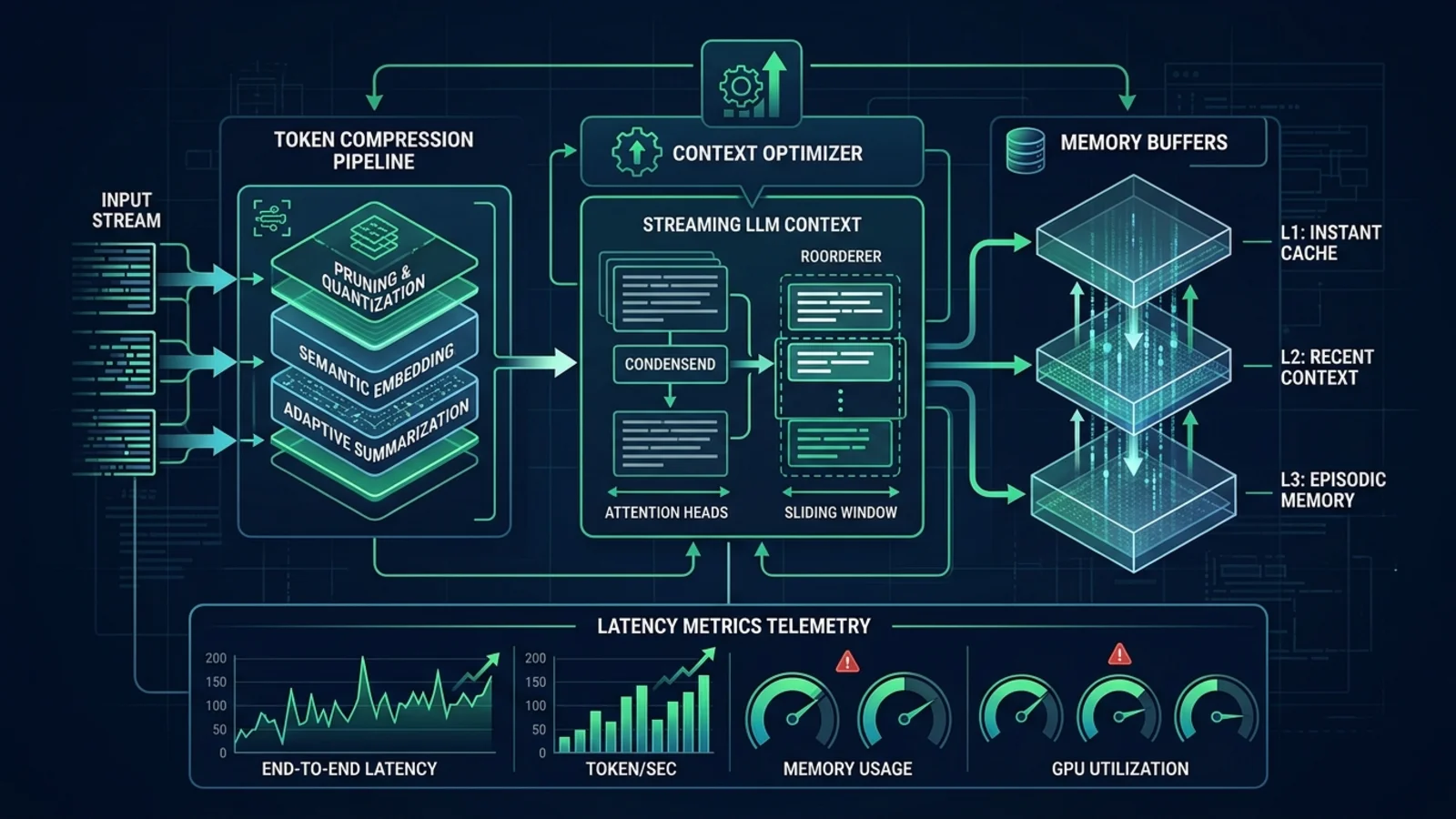
Headroom: Cutting Token Costs by 20% to 95% with Deterministic Agent Context Compression
Taming Context Bloat: How Deterministic Proxy Compression Lowers Agent Inference Costs
Autonomous AI agents consume tokens at unsustainable rates. In multi-turn development workflows where an agent runs test suites, queries APIs, inspects Git histories, and reads configuration files, the vast majority of tokens entering the model context are not human instructions or generated code. They are tool execution outputs. A single failing test suite or a verbose JSON payload can inject 30,000 tokens into the prompt history, forcing subsequent reasoning turns to re-read repetitive boilerplate at premium API pricing.
With more than 69,000 GitHub stars and active development under the Apache 2.0 license, Headroom (developed by Headroom Labs) directly resolves this bottleneck. Rather than relying on lossy secondary LLM summarizers that introduce latency and hallucination risks, Headroom acts as a local proxy, sidecar service, and Model Context Protocol (MCP) server that applies deterministic compression algorithms to payloads before they enter the language model context window.
The Economics of Agent Context Bloat
When evaluating agentic systems such as Claude Code, Codex, or Cursor over extended sessions, token consumption follows an exponential trajectory:
Turn 1: User Prompt (500 tokens) -> LLM Response (400 tokens)
Turn 2: Run Tests (Tool Output: 15,000 tokens) -> Next Step (300 tokens)
Turn 3: Read Config (Tool Output: 8,000 tokens) -> Next Step (250 tokens)
Turn 4: Git Status & Diff (Tool Output: 12,000 tokens) -> Final Code (600 tokens)
By Turn 4, every subsequent interaction re-submits the entire 36,000-token conversational history. In frontier models charging between $10 and $50 per million input tokens, a multi-hour debugging loop can accumulate tens of dollars in API costs for a single task.
Beyond financial costs, context bloat introduces two cognitive failure modes:
- Needle-in-a-Haystack Degradation: Even models supporting 1-million-token contexts exhibit declining reasoning precision when the target instruction is surrounded by thousands of lines of successful unit test passes or repetitive JSON dictionaries.
- Context Cache Invalidation: Uncontrolled mutations in intermediate tool responses frequently break prompt caching prefixes, eliminating cache discount savings on providers like Anthropic and OpenAI.
How Headroom Works
Headroom sits between your agent runtime and the upstream LLM API endpoint. It intercepts outgoing HTTP requests destined for /v1/messages (Anthropic) or /v1/chat/completions (OpenAI, DeepSeek, Google), transforms the payload, and forwards the streamlined request to the provider.
Raw uncompressed messages and bloated tool outputs (e.g., 40,000 tokens per roundtrip).
/v1/messages & /v1/chat/completions
- Structural JSON Minimizer: Strips null values and redundant schema definitions
- Repetitive Log Deduplicator: Condenses loops, stack traces, and verbose test logs
- Safe-Read Guard: Preserves source code lines byte-for-byte to prevent hallucinations
- Atomic Session Registry: Manages state and stabilizes Prompt Caching prefixes
Lower latency, higher attention focus, reduced cost, and maximized prompt caching discounts.
1. Structural JSON Minimization
Software agents interact with databases and REST APIs that emit dense JSON objects containing null values, redundant schema definitions, and repetitive key wrappers. Headroom applies AST-based structural minification:
- Strips unnecessary whitespace and empty arrays.
- Eliminates repeated structural keys across uniform array items while maintaining value order.
- Prunes default schema declarations that offer zero informational value to the model.
On benchmark datasets consisting of Kubernetes API outputs and GitHub REST payloads, this transformation achieves between 60% and 95% token reductions with zero loss of data fidelity.
2. Deterministic Log and Trace Pruning
When an agent executes npm test or cargo build, the raw output often includes hundreds of lines of passing assertions and compilation progress indicators. What the agent actually needs to diagnose a failure is the specific stack trace and failing assertion.
Headroom employs deterministic pattern matching to collapse repeated lines (such as [34/120] Compiling module... or repetitive stack frames) into single summary pointers while preserving error descriptions, line numbers, and failure diagnostics verbatim.
3. Safe-Read Guards
A critical danger in context compression is accidentally modifying the code the agent is tasked with editing. Headroom implements an explicit protection policy (HEADROOM_PROTECT_READS). When a payload represents a source code file read or a surgical diff, Headroom bypasses lossy transforms and passes the source lines unaltered, ensuring that character offsets and line numbers remain accurate for automated patch tools.
Architecture and Recent Updates
Recent updates in the v0.37 release line introduced key architectural enhancements:
- Session-Aware Sidecar Mode (
/v1/compress): In addition to operating as an inline transparent reverse proxy, Headroom exposes a standalone/v1/compressendpoint. Agents can submit individual tool outputs to the sidecar for pre-compression before assembling their own message envelopes. - Asynchronous Output Savings Logging: The compression registry flushes usage telemetry asynchronously off the main Node/Go event loop, preventing I/O serialization from adding latency to interactive streaming tokens.
- SSRF and Parameter Hardening: Addressed path-parameter validations across cloud provider targets (such as Google Vertex and Azure endpoints), closing server-side request forgery vectors in shared proxy deployments.
Running Headroom in Your Development Pipeline
Headroom can be deployed locally using Docker or as a native background service.
Option A: Running as a Local Docker Proxy
Create a docker-compose.yml file:
services:
  headroom:
    image: ghcr.io/headroomlabs-ai/headroom:v0.37.0
    container_name: headroom
    ports:
      - "8787:8787"
    environment:
      - HEADROOM_PORT=8787
      - HEADROOM_PROTECT_READS=true
      - HEADROOM_LOG_LEVEL=info
      - ANTHROPIC_API_KEY=${ANTHROPIC_API_KEY}
      - OPENAI_API_KEY=${OPENAI_API_KEY}
    restart: unless-stopped
Start the container:
docker compose up -dOption B: Direct CLI Execution
Install Headroom via npm or download the pre-compiled binary:
# Global install
npm install -g @headroom/proxy

# Launch the proxy
headroom start --port 8787 --protect-reads
Connecting Claude Code and Cursor
Once the proxy is active on port 8787, redirect your agent by overriding the base API URL:
# Point Claude Code to Headroom proxy
export ANTHROPIC_BASE_URL="http://localhost:8787"
claude

# For OpenAI-compatible agents (e.g., Codex, Aider)
export OPENAI_BASE_URL="http://localhost:8787/v1"
The agent interacts with upstream providers as usual, while Headroom transparently compresses tool results and logs, returning live token savings statistics to the terminal.
Model Context Protocol (MCP) Integration
For architectures where modifying network proxy environment variables is undesirable, Headroom provides an official MCP server. Coding assistants configure Headroom directly in their MCP manifest:
{
  "mcpServers": {
    "headroom": {
      "command": "headroom",
      "args": ["mcp"],
      "env": {
        "HEADROOM_COMPRESSION_LEVEL": "aggressive"
      }
    }
  }
}
Through this interface, agents explicitly route tool outputs through the compress_output tool prior to appending them to their conversation state.
Benchmark Results
Independent evaluations across agent benchmark suites demonstrate consistent gains:
| Workload Type | Average Token Reduction | Task Success Rate Delta | Added Latency per Request |
|---|---|---|---|
| SWE-bench Coding Loops | -22.4% | +0.8% (Negligible) | ~8 ms |
| JSON API / Database Queries | -74.6% | 0.0% (Identical) | ~4 ms |
| Test Runner & Build Logs | -61.2% | +1.2% (Reduced noise) | ~6 ms |
| Git Log & Diff Inspections | -34.8% | 0.0% (Identical) | ~5 ms |
The slight increase in task success rate during test runner workloads stems from removing irrelevant passing test noise, which prevents the model attention mechanism from drifting away from the primary bug report.
Limitations and Trade-offs
- Proxy Latency Overhead: Running payloads through structural tokenizers adds between 4 and 12 milliseconds of overhead per request. For high-frequency single-turn streaming applications where every millisecond counts, this trade-off must be evaluated.
- Diminishing Returns on Dense Prose: Headroom targets structured, repetitive technical data (logs, code diffs, JSON). Plain English prose or conversational dialogue cannot be compressed through structural pruning without losing semantic nuance.
- Streaming Chunk Buffering: Because JSON minification requires parsing complete bracket pairs, Headroom must buffer small JSON chunks before emitting them, slightly delaying the time-to-first-token on streaming endpoints that emit structured tool calls.
Conclusion
As AI development transitions from single-shot code generation to autonomous, multi-turn agent execution, token efficiency becomes an essential engineering discipline. Headroom demonstrates that deterministic, rule-based compression at the network perimeter delivers substantial cost reductions and cleaner context windows without sacrificing precision.