GyroidVault: Self-Hosted 3D Model Vault with In-Place ZIP Streaming and Multi-Part Studio
GyroidVault: Sovereign 3D Model Management for Makers and Print Farms
Managing a private 3D printing library on a home server usually degrades into an unindexed folder hierarchy filled with chaotic downloads from MakerWorld, Printables, and Thingiverse. Opening a desktop slicer just to check the scale of an STL or confirm which parts belong to a multi-body assembly wastes system memory and developer time.
The GyroidVault project, released under the AGPL-3.0 license, solves this operational friction. With its major v2.0 release in September 2026, GyroidVault introduces an in-browser WebGL inspection studio, physical millimeter dimension calculation, memory-safe asynchronous NAS scanning, and streaming inspection of compressed ZIP archives without disk extraction.
What It Is
GyroidVault is a lightweight web application that runs on local hardware or NAS appliances to catalog, inspect, and organize 3D printing assets. It supports STL, 3MF, STEP, and G-Code files through an interface reminiscent of media platforms like Jellyfin, but tailored specifically to additive manufacturing workflows.
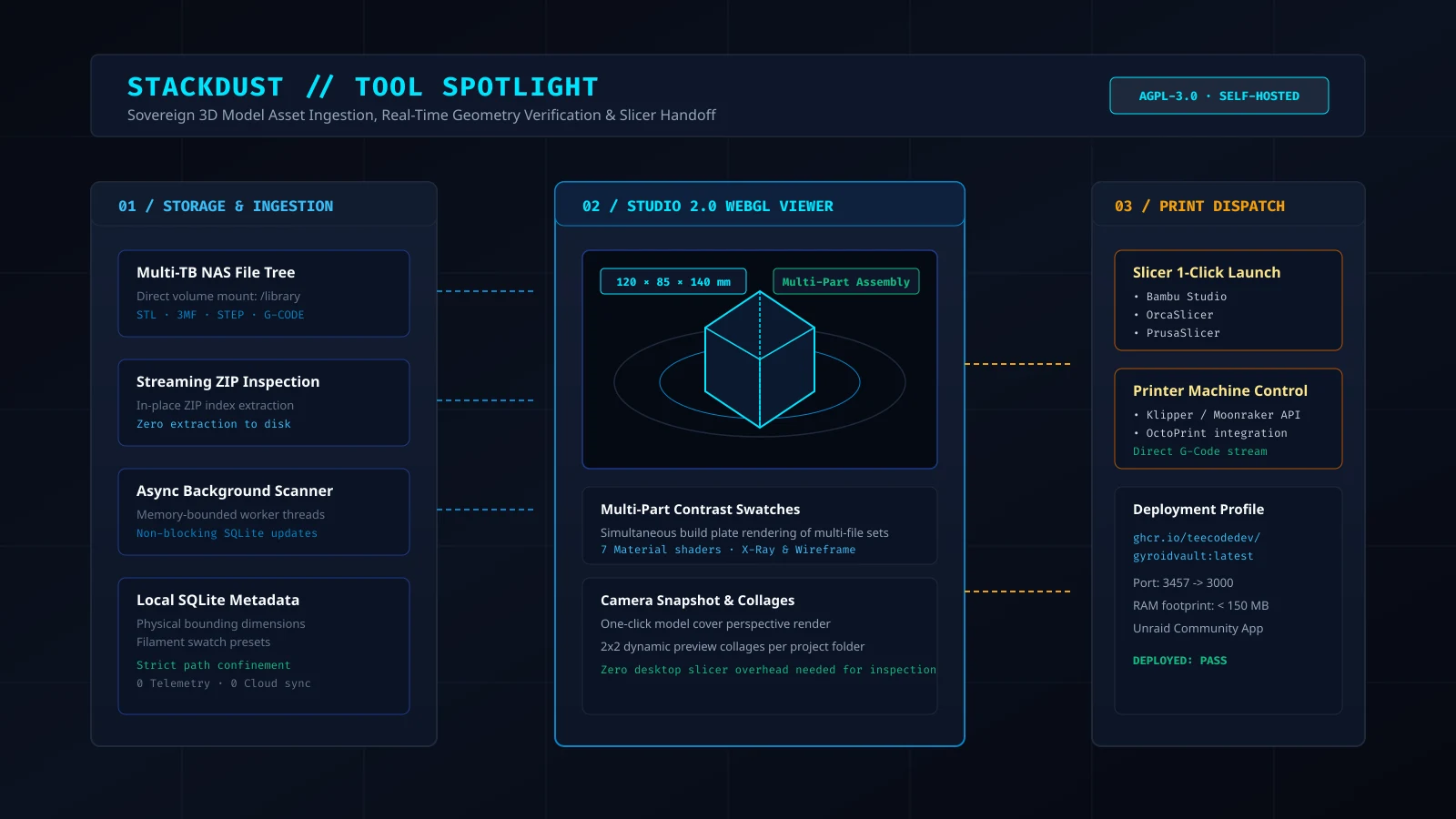
Rather than treating 3D files as raw binary blobs, GyroidVault parses geometric metadata upon ingestion. The platform displays real-time millimeter dimensions (W x D x H mm), isolates individual sub-meshes in multi-part projects, creates automatic 2x2 collage previews for nested folders, and bridges model storage directly to physical printers.
Why You Have Not Heard Of It
GyroidVault was developed independently by a solo maker without venture capital backing, marketing campaigns, or corporate sponsorship. Most 3D printing software ecosystems are heavily dominated either by proprietary cloud platforms tied to printer manufacturers or by desktop slicer applications that were never engineered to serve as multi-user asset repositories.
The project gained traction in homelab communities because it operates completely offline. It requires zero cloud accounts, collects no usage telemetry, and enforces strict filesystem path confinement to protect the host machine.
How It Works
GyroidVault couples a Node.js runtime with an embedded SQLite database and a Three.js WebGL rendering pipeline. Its operational architecture focuses on zero-copy asset reading:
Asynchronous worker threads scan mounted NAS volumes, indexing STL, 3MF, and STEP files with bounded memory allocation.
Extracts file central directories from raw archives in-place, streaming 3D meshes to client browsers without uncompressing to host storage.
Renders multi-part assemblies on a virtual build plate, applies filament color swatches, and calculates exact bounding box dimensions in millimeters.
Dispatches native URI protocols to launch Bambu Studio, OrcaSlicer, or PrusaSlicer, or integrates alongside companion tools like [Bambuddy](/en/blog/bambuddy-self-hosted-3d-printing-en/) to stream sliced G-Code directly to Moonraker endpoints.
Streaming ZIP Inspection
A persistent headache in 3D printing is that downloaded models often arrive inside nested ZIP files containing dozens of variations, PDF build guides, and rendering mockups. Unpacking every archive wastes terabytes of NAS storage.
GyroidVault reads the ZIP central directory header over HTTP Range requests. When a user navigates into an archive in the web interface, the server extracts and streams only the requested mesh to the browser memory. The host filesystem remains pristine, and no temporary scratch files accumulate on disk.
Studio 2.0 Multi-Part Assembly
In standard file browsers, an assembly split into six STL files requires opening each part sequentially. GyroidVault Studio 2.0 provides an “All Parts Combined” toggle. The WebGL viewer positions every sub-component on the virtual build plate simultaneously, assigning distinct filament color swatches to each mesh to verify assembly fit before printing.
Comparative Feature Analysis
GyroidVault Architecture vs Alternative Solutions
| Capability | GyroidVault v2.0 | Generic NAS Web Explorer | Desktop Slicers (Orca / Bambu) |
|---|---|---|---|
| In-Place ZIP Inspection | Native HTTP streaming | Requires extraction | Requires manual unpack |
| Millimeter Bounding Box | Automatic WebGL calculation | None | Available only after load |
| Multi-Part Build Plate View | Browser-based multi-mesh | None | Heavy desktop UI |
| Hardware Footprint | Single container, < 150MB RAM | Low | 800MB+ to 2GB RAM |
| Direct Slicer Handshake | 1-Click protocol handler | Manual download | Native |
| Network Telemetry | 0 external calls | Dependent on app | Frequent vendor telemetry |
Running It
GyroidVault is packaged as a lightweight rootless container. It maps two primary paths: a persistent /app/data volume for the internal SQLite database and configuration, and a read-only or read-write mount to your existing model storage library.
services:
  gyroidvault:
    image: ghcr.io/teecodedev/gyroidvault:latest
    container_name: gyroidvault
    restart: unless-stopped
    ports:
      - "3457:3000"
    volumes:
      - ./data:/app/data
      - /mnt/storage/3d-models:/library
    environment:
      - NODE_ENV=production
      - PORT=3000
      - LIBRARY_PATH=/library
For Unraid users, the application is also available directly through the Unraid Community Applications store under the name GyroidVault.
What It Replaces
GyroidVault replaces scattered shared folders, generic file managers like Nextcloud that choke on 3D thumbnail generation, and cloud-bound maker profiles. It eliminates the routine friction of having to download a 500MB ZIP file locally just to verify whether a model requires supports or fits inside your printer’s build volume.
Limitations
- G-Code Simulation: While GyroidVault catalogs G-Code files and streams them to Moonraker or OctoPrint, it does not include a full layer-by-layer toolpath simulator. Complex nozzle travel path verification still requires a dedicated slicer.
- Parametric CAD Editing: GyroidVault inspects geometries, measures bounding volumes, and displays assemblies, but it is not a CAD editor. Modifying internal STEP geometry requires FreeCAD, Fusion, or Onshape.
- Single-Node Scanner: In multi-node clustering scenarios, the background file scanner runs as a single coordinator process inside the container. Scanning an initial 5TB library with hundreds of thousands of files requires several hours on spinning mechanical disks.
Who It Is For
GyroidVault is purpose-built for homelab operators, 3D printing enthusiasts, and small print farm managers who demand total privacy and rapid model lookup. If your server holds a growing archive of STLs and you want immediate visual scale confirmation without launching heavy desktop software, GyroidVault is ready for production deployment.
Conclusion
GyroidVault v2.0 brings order to one of the most disorganized corners of the maker ecosystem. By combining in-place ZIP streaming, real-time millimeter geometry calculation, and zero-telemetry AGPL-3.0 software architecture, it establishes an essential utility for self-hosted additive manufacturing.