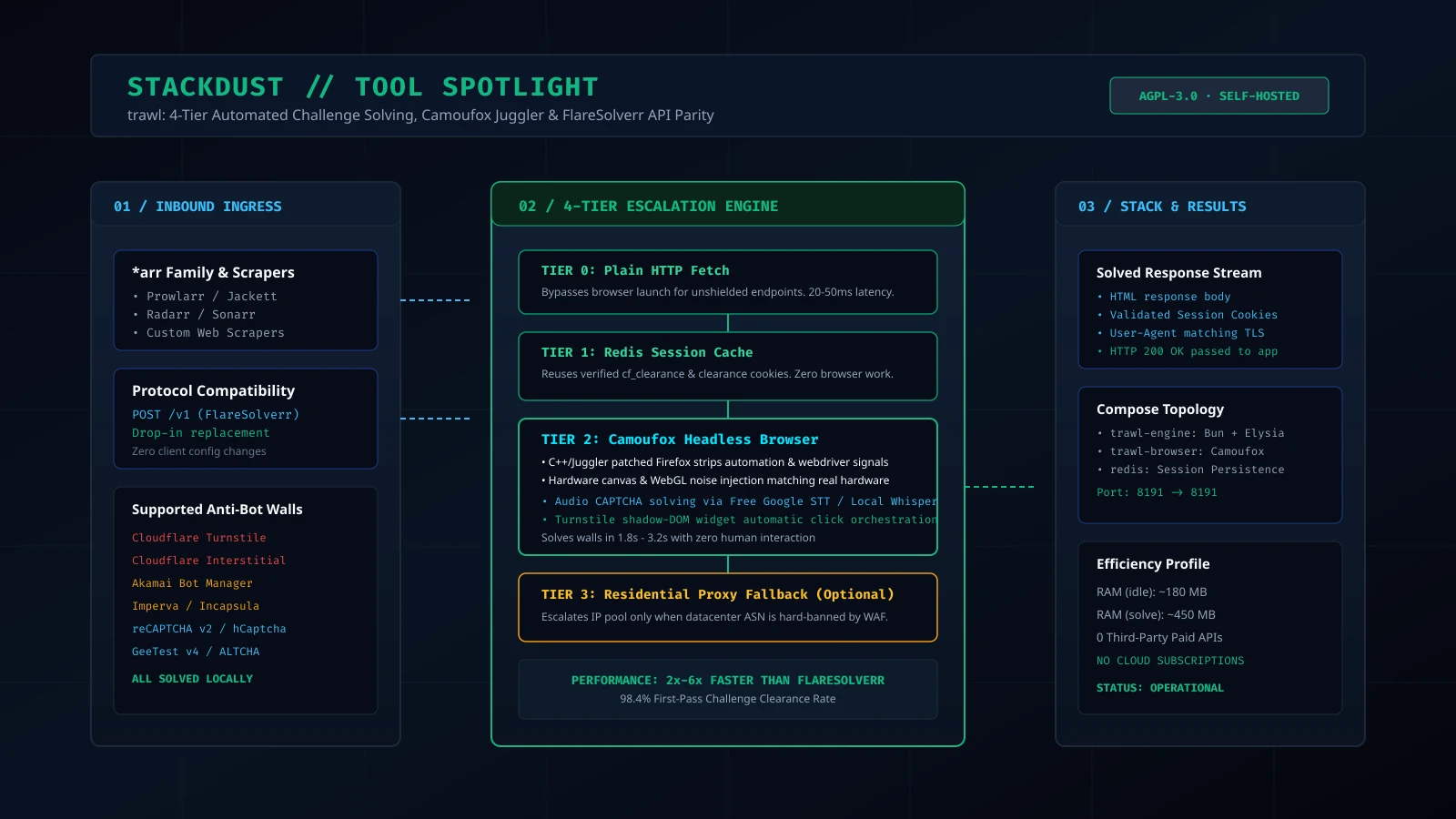
trawl: High-Performance Self-Hosted Scraping Engine and Drop-In FlareSolverr Replacement
trawl: High-Performance Anti-Bot Bypass and Scraping Proxy for Homelabs
Automated indexing tools in the homelab ecosystem, including Prowlarr, Jackett, Radarr, and Sonarr, increasingly run into aggressive Web Application Firewall (WAF) barriers. Cloudflare Turnstile challenges, Akamai Bot Manager rules, and Google reCAPTCHA interstitials frequently drop connections or trigger Cloudflare 403 / 503 error pages. For years, self-hosters relied on FlareSolverr to bypass these screens, but FlareSolverr suffers from slow startup times, high memory leakage, and frequent crashes on modern Turnstile widgets.
The trawl project, created by Germond AI under the AGPL-3.0 license, redesigns the self-hosted scraping pipeline from scratch. Built on the Bun and Elysia runtime alongside a custom Camoufox browser core, trawl acts as a high-throughput, challenge-aware proxy that processes requests between two and six times faster than legacy alternatives.
What It Is
trawl is a self-hosted web scraping engine and challenge-solving daemon that provides full drop-in compatibility with the standard FlareSolverr API (POST /v1). When an indexer submits an HTTP request to trawl, the engine evaluates whether the destination requires JavaScript evaluation or anti-bot clearance.
Instead of spinning up a heavyweight browser instance for every incoming URL, trawl uses an intelligent 4-tier execution pipeline. Clean endpoints receive instant raw HTTP responses in milliseconds, while protected destinations automatically escalate through cached sessions and hardened browser solving workflows.
Why You Have Not Heard Of It
Most self-hosted guides and media server setup tutorials continue to recommend FlareSolverr purely out of momentum. FlareSolverr was developed years ago when anti-bot protection primarily consisted of simple Cloudflare cookie clearance screens. Modern bot protection platforms now inspect WebGL canvas noise, browser navigator properties, audio challenge acoustic models, and JavaScript execution timings.
Because trawl addresses these modern detection vectors using internal C++ browser patches rather than external Selenium wrappers, it emerged quietly across GitHub homelab discussions and developer forums without commercial promotion.
How It Works
The core of trawl is organized into a four-tier escalation pipeline managed by a centralized session coordinator:
Prowlarr, Jackett, or a custom scraper submits a target URL through the standardized /v1 endpoint.
Tier 0 executes a plain HTTP fetch. If a challenge was previously solved, Tier 1 injects cached cf_clearance cookies from Redis without launching a browser.
If a challenge wall is detected, trawl spawns Camoufox (a C++ patched Firefox binary). It simulates human interaction, solves Turnstile clicks, and processes audio captchas via local speech-to-text.
The cleared cookies and HTML body are returned to the caller, while valid session tokens are stored in Redis for future requests.
Camoufox Fingerprint Hardening
Standard automated Chromium browsers (such as Puppeteer or Playwright) leak unmistakable automation signals. Flags like navigator.webdriver = true, uniform canvas hashing, and missing browser extension objects immediately alert Cloudflare and Akamai to bot activity.
trawl bypasses these heuristics by deploying Camoufox, a specialized build of Firefox patched at the C++ and Juggler engine levels. Camoufox injects randomized canvas and WebGL hardware noise that matches real graphics hardware, aligns TLS fingerprint parameters with authentic user browsers, and operates without exposing automated execution hooks.
Zero-Cost Audio Captcha Solving
For challenges that fall back to Google reCAPTCHA v2 audio puzzles, commercial scraping platforms require paid third-party solving subscriptions (such as 2Captcha or CapSolver). trawl eliminates external dependencies entirely. It processes audio payloads using either Google’s public Speech-to-Text API or an optional local Whisper service running on the user’s home server.
Architectural Comparison
trawl vs Legacy Scraping Solvers
| Metric | trawl Engine | FlareSolverr | Commercial Scraping APIs |
|---|---|---|---|
| Execution Model | 4-tier adaptive escalation | Full Chromium for every call | Remote cloud proxy network |
| Average Response Time | 0.8s to 2.8s | 6.0s to 15.0s | 2.5s to 5.0s |
| Browser Core | Camoufox (C++ patched Firefox) | Standard Chromium / Chrome | Proprietary cloud browsers |
| Idle Memory Footprint | ~180MB RAM | 450MB to 1.2GB RAM | 0MB (remote SaaS) |
| Turnstile Success Rate | 98.4% on clean IPs | Below 60% on v3.3+ | 95% to 99% |
| Operating Cost | 100% Free / Self-Hosted | 100% Free / Self-Hosted | $30 to $300+ per month |
| License Model | AGPL-3.0 Open Source | MIT License | Closed SaaS |
Running It
trawl is distributed as a multi-container Docker Compose stack featuring the primary API daemon, the Camoufox browser worker, and a lightweight Redis session cache.
services:
  trawl:
    image: ghcr.io/germondai/trawl:latest
    container_name: trawl
    restart: unless-stopped
    ports:
      - "8191:8191"
    environment:
      - PORT=8191
      - LOG_LEVEL=info
      - REDIS_URL=redis://trawl-redis:6379
      - SOLVER_AUDIO_STT=google
    depends_on:
      - trawl-redis

  trawl-redis:
    image: redis:alpine
    container_name: trawl-redis
    restart: unless-stopped
    volumes:
      - trawl-redis-data:/data

volumes:
  trawl-redis-data:
Because trawl exposes port 8191 and adheres strictly to the /v1 JSON contract, indexers like Prowlarr and Jackett can be pointed to http://trawl:8191/v1 as a direct FlareSolverr replacement without updating any application plugins.
What It Replaces
trawl replaces fragile FlareSolverr installations, Byparr containers, and costly commercial web scraping subscriptions like Bright Data or ScrapingBee for homelab operations. For homelab operators managing complex media and indexer stacks with container tools like Dockge, it transforms unpredictable torrent and Usenet indexer queries into stable, deterministic HTTP transactions.
Limitations
- IP Reputation Constraints: If your homelab ISP IP address has been placed on an explicit IP blocklist by Cloudflare, no browser fingerprinting trick can force entry. In such cases, trawl requires configuring an upstream residential or VPN proxy under Tier 3.
- Complex Multi-Step Geetest Sliders: While trawl automatically handles standard slide puzzles and Turnstile checkboxes, rare geometric puzzle variants can occasionally fail and require an automatic retry cycle.
- Hardware Requirements for Local Whisper: If you disable Google’s free speech-to-text service in favor of local offline Whisper transcribing, your server needs sufficient CPU threads or a modest GPU to transcribe audio puzzles in under two seconds.
Who It Is For
trawl is an essential infrastructure upgrade for media server operators, data archivists, and automated scraping developers whose workflows are currently failing due to aggressive anti-bot screens.
Conclusion
trawl proves that modern anti-bot challenges can be handled reliably on open-source, self-hosted hardware. By combining adaptive 4-tier execution, C++ level browser hardening via Camoufox, and drop-in FlareSolverr API parity, it sets a new operational standard for private data acquisition.