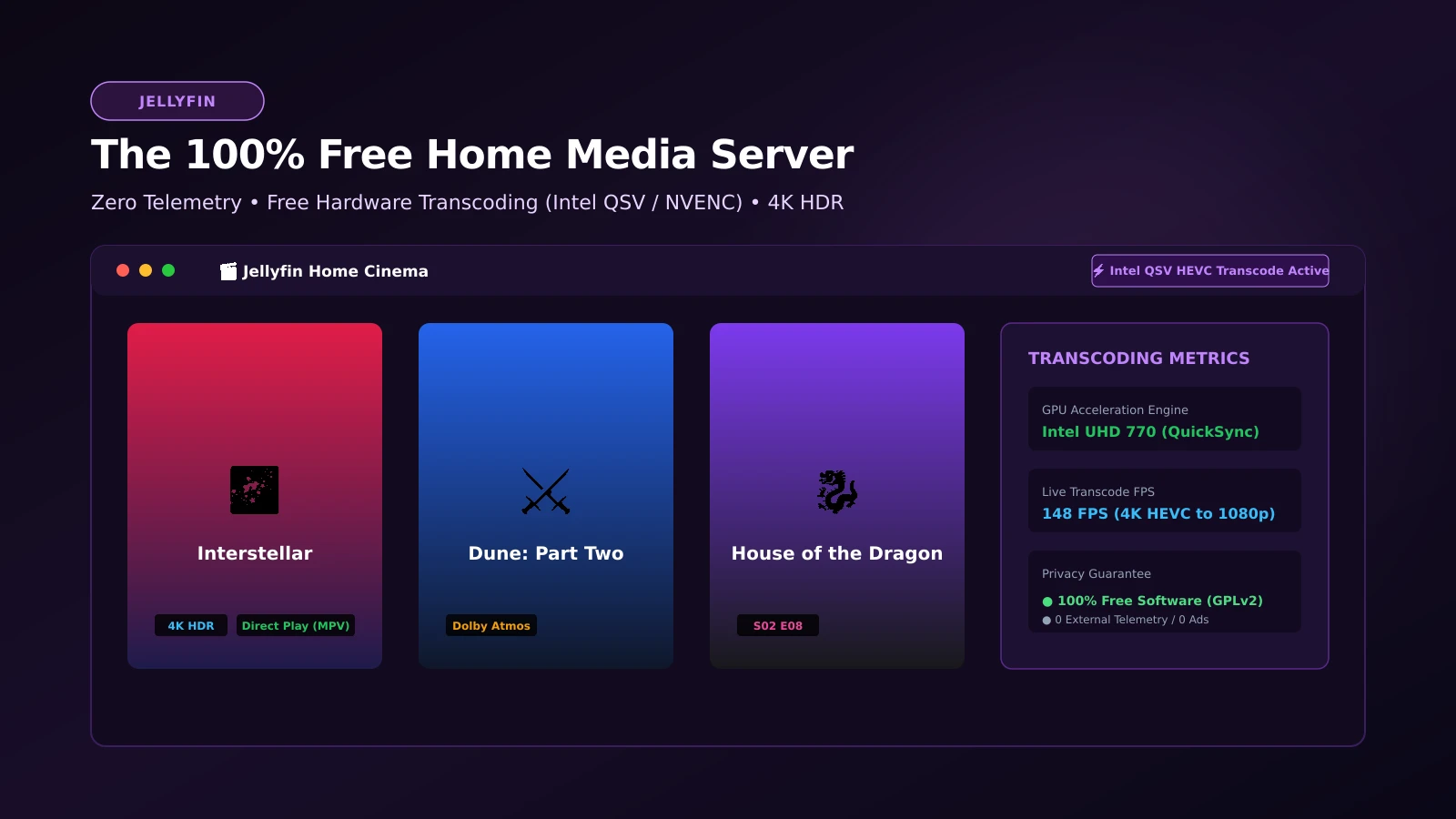
Jellyfin: The Complete Open-Source Home Media Server & Transcoding Guide
Sovereign Entertainment: 100% Free Media Streaming with Jellyfin
Home media streaming servers have undergone troubling commercial shifts: proprietary options like Plex have introduced mandatory remote cloud authentication, invasive telemetry collection, ad-supported free tiers, and paywalled hardware transcoding behind monthly subscription passes (Plex Pass). Jellyfin represents the definitive free software alternative, restoring total ownership to your digital media collection.
Published as 100% free software under the GNU GPL-2.0 license, Jellyfin carries zero subscriptions, zero artificial feature gates, and zero external telemetry. It provides seamless 4K HDR playback, lossless audio streaming, and unrestricted GPU hardware acceleration across all major platforms.
What It Is
Jellyfin is an open-source media server and client ecosystem created as a community fork of Emby following its codebase closure. It catalogs multi-terabyte media libraries, auto-fetches high-resolution artwork and subtitles, and orchestrates user accounts with granular parental controls.
The platform boasts a comprehensive client ecosystem: native applications for Android TV, Apple TV, Roku, LG webOS, Samsung Tizen, iOS, Android, and high-performance MPV desktop players (Jellyfin Media Player, Swiftfin).
Why You Have Not Heard Of It
Jellyfin is held in reverence across homelab communities for its uncompromising philosophy: “No accounts, no tracking, no paywalls.” The server functions 100% offline during internet blackouts, cementing its status as an indispensable pillar of private home infrastructure.
How It Works
Jellyfin combines modern .NET Core architecture with a customized FFmpeg media pipeline:
- Unrestricted Hardware Acceleration: Natively dispatches transcoding pipelines to Intel QuickSync (QSV), NVIDIA NVENC, AMD VA-API, and Apple VideoToolbox without license fees.
- HDR Dynamic Tone Mapping: Accurately maps HDR10, HLG, and Dolby Vision color profiles to standard dynamic range (SDR) displays in real time without color washing.
- Automated Metadata & Subtitle Ingestion: Scrapes metadata from TMDB and Fanart.tv, while fetching synchronized subtitles on-demand via integrated OpenSubtitles providers.
Step-by-Step Deployment Guide
Deploying Jellyfin with hardware acceleration pass-through on Docker Compose (example: Intel QuickSync):
services:
  jellyfin:
    image: jellyfin/jellyfin:latest
    container_name: jellyfin
    restart: unless-stopped
    ports:
      - "8096:8096"
    volumes:
      - ./config:/config
      - ./cache:/cache
      - /path/to/media/movies:/media/movies:ro
      - /path/to/media/shows:/media/shows:ro
    devices:
      # Pass through Intel integrated GPU render node for hardware transcoding
      - /dev/dri/renderD128:/dev/dri/renderD128
    environment:
      - TZ=UTC
      - JELLYFIN_PublishedServerUrl=http://192.168.1.50:8096
Start the service:
docker compose up -dNavigate to http://<SERVER_IP>:8096 to initiate the initial setup wizard, select metadata languages, and bind your media storage volumes.
What It Replaces
- Plex & Plex Pass Subscriptions: Eliminates paywalled hardware transcoding and cloud sign-in dependencies entirely.
- Commercial Video Streaming Subscriptions: Hosts personal home video archives and media in uncompressed original quality.
- Primitive DLNA Shares: Delivers rich metadata posters, cast profiles, intro skipping, and synchronized cross-device watch progress.
Limitations
Concurrent multi-stream 4K transcoding requires modern GPU/iGPU hardware; however, clients supporting Direct Play stream media directly with negligible server CPU overhead.
Who It Is For
- Cinephiles and audiophiles preserving uncompressed high-bitrate media libraries.
- Families seeking a secure, private home entertainment hub with zero tracking.
- Homelab operators running NAS storage clusters seeking a premier media front-end.
Conclusion
Jellyfin represents open-source software at its finest: powerful, beautiful, and completely respectful of user autonomy. It is the gold standard for sovereign home streaming.