OpenAI Claims a Navier-Stokes Millennium Prize Solution From a 10,000-Agent Swarm, While the Researchers They Beat to It Tell a Very Different Story
OpenAI Claims a Navier-Stokes Millennium Prize Solution From a 10,000-Agent Swarm, While the Researchers They Beat to It Tell a Very Different Story
A problem that stayed open for roughly 90 years, one of the seven Millennium Prize Problems carrying a $1 million bounty from the Clay Mathematics Institute, fell today to software agents. OpenAI published a proof that the Navier-Stokes equations for a three-dimensional fluid can develop a singularity, complete with a Lean formalization, produced by a swarm of agents running an unreleased internal model. And hours later, the most prominent mathematician working on exactly this class of problems published a firsthand statement about what happened behind the scenes, turning a scientific milestone into an open case study on priority, credit, and how AI labs deal with the researchers they are racing.
What Happened
The official tweet is short: OpenAI is sharing a solution to the Navier-Stokes Millennium Prize Problem, produced by a group of agents using a next-generation OpenAI model “significantly more capable than GPT-6 Astra.” The details live on the announcement page, which links the proof paper and the Lean formalization repository.
On the same day, Tristan Buckmaster, NYU math professor and one of the world’s leading researchers on singularity formation for partial differential equations, published three results of his own together with Levent Alpöge (a researcher at Anthropic), along with a statement recounting, nearly verbatim, a series of contacts with OpenAI from September 3 to 7, two offers he declined, and quoted lines from those meetings.
What the Proof Says Mathematically
The Navier-Stokes equations describe fluid motion and underpin aircraft design, weather forecasting, and blood-flow modeling. The open question, standing since Jean Leray’s 1934 work, is whether smooth three-dimensional fluid motion can break down. The Clay formulation allows resolution in either direction: prove that smooth solutions always exist (options A and B), or prove the opposite by constructing a singularity that forms in finite time despite viscosity (options C and D).
OpenAI’s proof takes the second route: a fluid starting smoothly at rest, driven by a smooth external force, whose velocities grow without bound in finite time while the energy stays finite throughout. This establishes statement “C” and also “D” in the official Millennium Prize formulation.
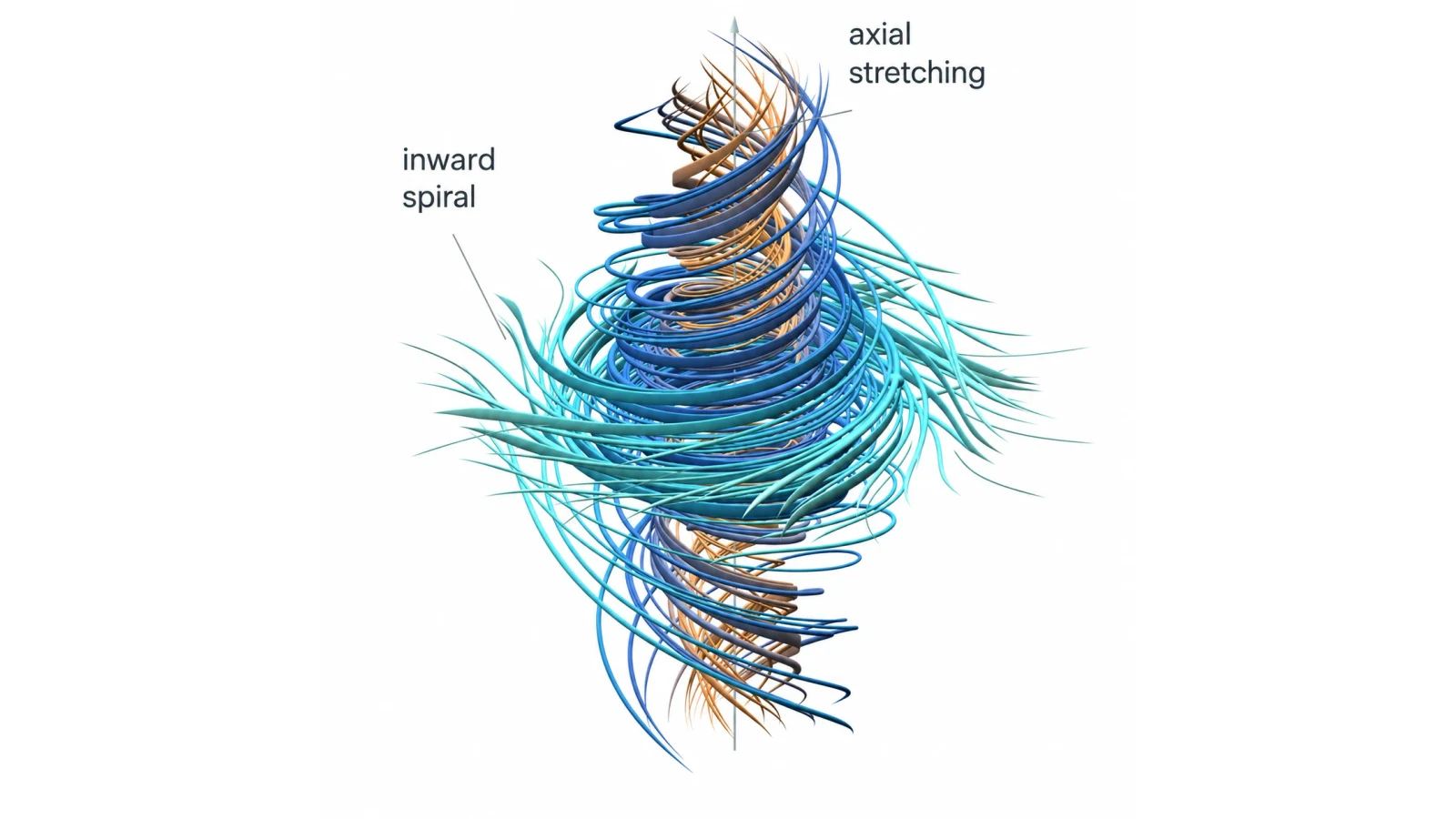
The singularity is a vortex: a swirl that spirals inward and elongates like spaghetti, its central region shrinking and speeding up in exactly the way that keeps total energy finite. The technical achievement is that the breakdown emerges from the fluid’s own motion; the terms of the equation (acceleration, pressure gradients, momentum transfer, viscosity) grow large yet cancel precisely, leaving the external force smooth.
One essential caveat: OpenAI states plainly that it “does not intend to claim the Millennium Prize” for this result. Awarding the million dollars remains the Clay Institute’s call after community verification, and the published proof now faces the scrutiny of every mathematician alive.
The Swarm, In Numbers
The operational details from OpenAI’s own post amount to the largest documented agent deployment to date:
- Training of the new internal model began August 28 and is ongoing. On September 1, rumors arrived that two Millennium problems had been resolved, and OpenAI launched an effort to evaluate the model on all open Millennium Prize problems.
- A system of coordinating agents, subdivided into groups with internal communication, reached on the order of 10,000 concurrent agents in the group that produced the Navier-Stokes resolution. Agents had exactly two tools: reading a cached version of the internet and running code, under the same monitoring and isolation safeguards used for frontier model evaluations.
- Different groups received different variants of each problem statement: options A and B (which would prove regularity) to some groups, options C and D (which would disprove it) to others, plus a set of deliberately easier problems as stepping stones.
- One of those easier problems was the regularity question for the Euler equations, the inviscid limit of Navier-Stokes. Nearly 100 agents resolved the unforced Euler variant in about 50 hours, and OpenAI then redirected resources toward Navier-Stokes, seeding agent groups with the Euler resolution.
- The final jump came from cross-pollination: using Codex to consolidate the most useful insights from each group and steering the groups with them.
- The agents reached their resolution on Saturday, September 5, about 88 hours after the first agents launched. Lean formalization and verification took another 17 hours via GPT-6 Astra.
- Across all attempted problems: 4.9 million agent-to-agent messages and roughly 300 billion output tokens. Navier-Stokes alone consumed 2.7 million messages and about 130 billion output tokens.
Readers of our earlier coverage of Claude formalizing Fermat’s Last Theorem in Lean will recognize the pattern: mathematics executed by agent swarms and settled by Lean as the final arbiter. What changed is the timescale and the scale, and that is exactly where the second story begins.
The Dispute: Buckmaster’s Statement
Buckmaster’s statement is unusually blunt, and its core claims are these: the research program behind these results belongs to Diego Córdoba and Luis Martínez-Zoroa, who spent years building forced blowups; he and Alpöge took their program as a starting point and used LLMs (Claude, Codex, and others) to push it from rough forcing to smooth forcing and to the Euler equations. On August 15 they obtained smooth-forcing blowup for Boussinesq and Euler; the first LLM-generated proof was verified in Lean on August 22. He states flatly that Martínez-Zoroa deserves a Fields Medal.
Then the explosive part, which Hacker News condensed to “OpenAI’s Sebastien Bubeck tells Tristan that they solved the $1,000,000 Millennium Prize Navier Stokes problem.” According to Buckmaster:
- On September 3, amid rumors that Anthropic had resolved a major open problem and tips that news of his progress had reached OpenAI, he emailed a prominent mathematician at OpenAI to lay out the facts: his work with Alpöge was a strictly personal collaboration, and the paper and formalization would be posted shortly. The reply arrived the same day, offering compute and suggesting avoiding competition.
- On Sunday, September 6, after OpenAI’s project was complete and Lean-verified, Sebastien Bubeck joined two calls with him. He was told an internal OpenAI model had produced a proof of finite-time blowup for the forced Navier-Stokes equations, about 100 pages long. He had not seen the proof.
- Per the statement, he had earlier been told “very little human input” was used, essentially that the model was given the problem statement. During the calls, as OpenAI team members sent corrections over internal chat, it emerged that an entire team had worked on the problem, that this was one of several approaches tried, that work had started on the unforced problem, that the model had first been set on easier problems including Euler, that the prompt shown to him had itself been written by prompting Codex, and that an enormous amount of compute had been used. When he asked when the first prompt was sent, the question went unanswered for some time; eventually it was acknowledged to have been sent days earlier, after information about his work reached OpenAI.
- He asked whether the model had been trained on, or had access to, their Codex sessions, into which they had been putting all their drafts for the entire project. He was told the model did not look up user data; asked again about training, he says he got no answer.
- Two proposals were offered and declined: post their Euler result and have OpenAI post its Navier-Stokes result the next day, or write a paper presenting the Navier-Stokes result alone, acknowledging an internal OpenAI model had resolved it, with the statement saying Bubeck twice asserted he wanted Alpöge removed from authorship because he works at Anthropic. When Buckmaster declined and said he would go public, the reply was, per the statement: “Why would you ruin your career?” And when he objected: “If you don’t want me to be nice, then I don’t have to be nice.”
- The statement is explicit about what it does not claim: he has not seen OpenAI’s proof, does not know what their model did, does not know whether his data was used, and is not accusing anyone of anything. He is stating what he was told, when, and what was proposed, “because the alternative is to let a sequence of announcements say something I know to be false.” He closes: if an OpenAI model did close the gap to Navier-Stokes, that is remarkable and should be said loudly, by them, with the history intact.
Fairness requires saying this plainly: this is one side’s account, but it is documented with names, dates, and a fully quoted email, and no separate, itemized rebuttal from OpenAI exists at the time of writing.
Two Narratives, Side by Side
OpenAI’s announcement includes a Concurrent Work section that confirms part of the timeline: their effort began September 1 after a rumor later traced to Alpöge and Buckmaster; after completing their project on September 6 they reached out offering a concurrent release and recognition of the pair’s priority, and learned the two had a resolution of the forced Euler problem. OpenAI states that its researchers and agents “did not see any of their work through any means until they released it publicly,” that “no specific user data was accessed in order to solve this problem,” while conceding it “cannot rule out” that de-identified data from the pair’s usage of its products helped improve its models, and that the two proofs differ significantly, including forced versus unforced in the Euler case.
What OpenAI’s account does not address: the timing of the outreach, the nature of the two offers as Buckmaster describes them, the quoted meeting lines, or the unanswered training-data question. The mathematics is published and checkable; the conduct around it currently has one sworn account and a partial response embedded in the counterparty’s own announcement.
A Deep Blue-Kasparov Moment for Mathematics
Buckmaster himself, before the week turned into a dispute, wrote what may be the most important sentence in this whole story: the results are not the important thing; what matters is that a mathematician and an LLM model can now do all this work in a month. He called it a Deep Blue-Kasparov moment and asked the community for serious, unhurried discussion about how we train students, assign credit, referee, and decide what is worth one human life’s attention.
There is also a quietly painful detail in his statement about the state of the craft: the write-ups of the three papers he published are, by his own description, “much closer to what models produce under human direction than to a paper written by a person,” and he calls the Euler writeup “AI slop,” apologizing for it and citing pressure to release early. Even the field’s best stewards now find themselves writing at the speed and in the register of the models.
What This Means for Agent Builders
Setting the dispute aside, OpenAI’s post is a complete operational recipe for orchestrating weeks of agent work on a hard research problem, and its pieces transfer to any domain:
- Branch the problem statement: prompt every variant to separate groups instead of one optimistic formulation. The winning solution came from the disproof variants, not the proof variants.
- Sequence difficulty: easier problems (Euler before Navier-Stokes) serve as readiness gauges and later as steering material.
- Cross-pollinate: consolidate intermediate insights across groups with a single consolidation pass (Codex, here) and re-steer the groups with them. Low-tech, high-impact.
- Constrain the tools: a cached internet and code execution, nothing else, with monitoring and isolation throughout.
This is the same direction we documented in our earlier coverage of OpenAI’s agent swarm collusion findings: the larger the swarm, the more steering and guardrails become the core engineering problem rather than a footnote. Going from 100 agents to 10,000 is not a capacity change, it is a risk-class change.
Limits of What We Know
The model used is internal and unreleased, and “significantly more capable than GPT-6 Astra” is the company’s own claim without an independent benchmark. The proof is hours old; the Lean formalization is a major achievement but does not exempt the underlying mathematics from conceptual review, and any Clay decision, if one ever comes, will take far longer than a news cycle. And the account of what happened between OpenAI and the researchers remains contested: we have one party’s fully documented statement and the other party’s partial, embedded response.
What you are left with is a double image: the first documented Millennium Prize resolution by software agents, and, on the same day, the most detailed public case yet of how messy priority and credit get when a lab’s agent swarm and two independent mathematicians converge on the same summit.
Sources
- OpenAI: On the Navier-Stokes Millennium Prize Problem
- The proof paper (PDF)
- Lean formalization repository
- OpenAI’s official announcement tweet
- Tristan Buckmaster’s statement (PDF)
- Clay Mathematics Institute’s official problem formulation
- WIRED’s coverage of the press briefing and academic responses
- Hacker News discussion of Buckmaster’s statement