Paperless-ngx: Automated Ingestion, OCR & Machine Learning Document Archiving
Sovereign Document Archiving: Conquering Paper Clutter with Local Machine Learning
Physical paper documents—tax filings, warranty receipts, medical histories, and utility bills—accumulate relentlessly in every home and office. Locating a specific invoice from three years ago in physical filing cabinets is an exercise in frustration. Paperless-ngx provides the definitive open-source solution, turning physical document scanners and mobile camera uploads into an automated, searchable digital document archive.
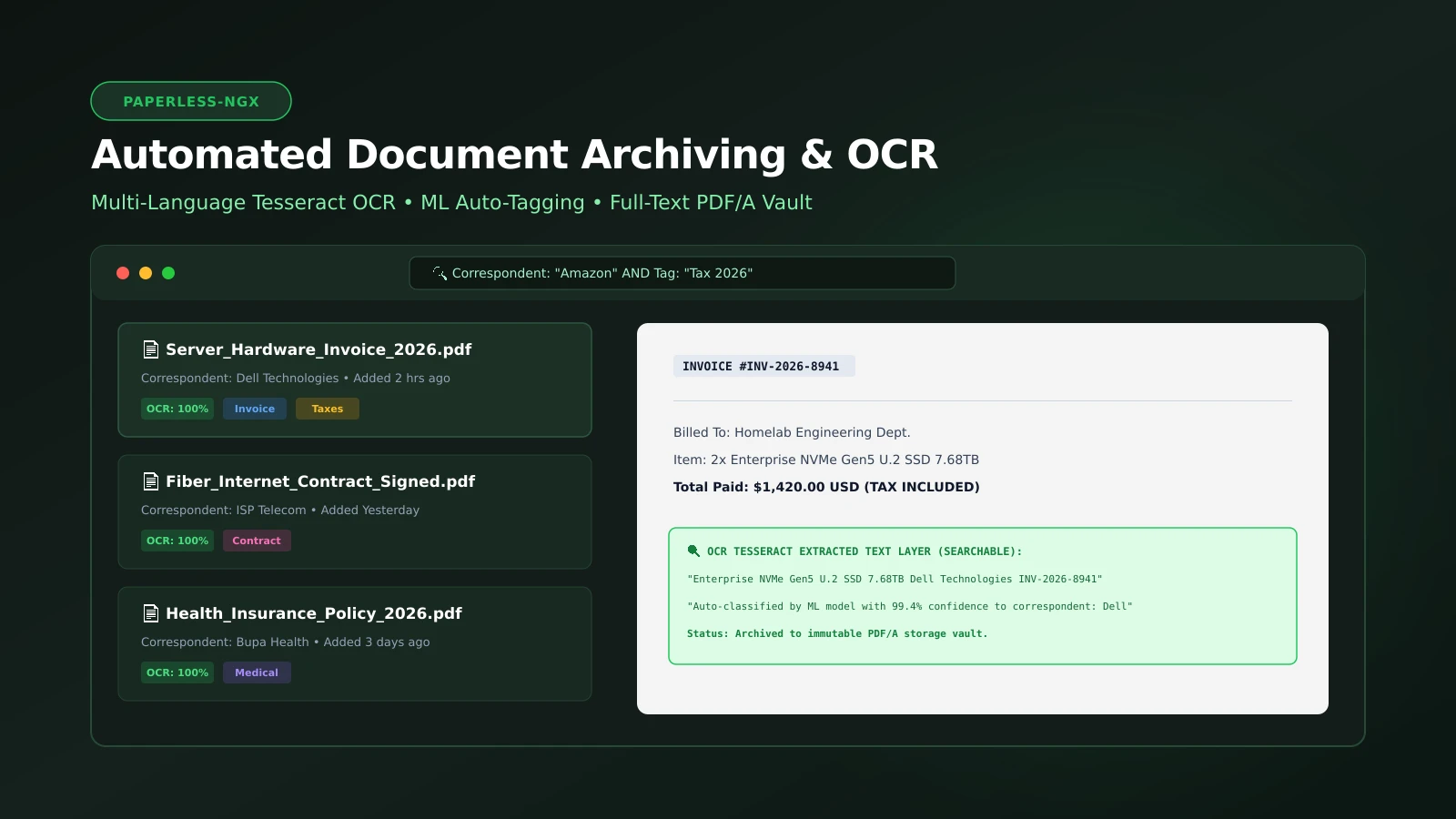
Featuring an automated ingestion pipeline that monitors network folders and IMAP email accounts, Paperless-ngx applies high-fidelity optical character recognition (OCR) to extract text, trains an internal machine learning model to predict document correspondents and tags, and archives standardized, immutable PDF/A files designed for multi-decade preservation.
What It Is
Paperless-ngx is a full-featured, open-source (GPL-3.0) electronic document management system (EDMS). It delivers a responsive web interface powered by full-text search indices, multi-factor authentication, granular tag hierarchies, and structured disk storage mirroring human-readable directory conventions.
Advanced features include automated barcode detection for multi-page document batch splitting, multi-language OCR dictionaries, customizable storage paths, and an automated audit pipeline that requires zero manual intervention once configured.
Why You Have Not Heard Of It
Born out of the community continuation of the original Paperless project, Paperless-ngx has become an essential pillar of modern homelab culture. By merging battle-tested OCR engines with practical, self-learning machine learning algorithms, it has turned “paperless living” from an aspiration into a dependable reality.
How It Works
The Paperless-ngx pipeline processes inbound files through coordinated asynchronous stages:
- Ingestion Watchers: Continuously polls a local
consumedirectory or queries designated IMAP email inboxes for PDF, TIFF, JPEG, or Office attachments. - OCR & Text Extraction Engine: Dispatches files to Tesseract OCR and Ghostscript to extract text layers, generate searchable PDF/A archives, and create vector thumbnails.
- Machine Learning Classifier: Employs Scikit-Learn neural classifiers to automatically assign tags, correspondents, and document types based on historical text patterns.
- Full-Text Indexing (Tantivy / Whoosh): Indexes every extracted word into a high-speed search index, enabling instant substring, exact phrase, and fuzzy boolean searches.
Step-by-Step Deployment Guide
Deploying Paperless-ngx with PostgreSQL and Redis ensures optimal performance and durability:
services:
  broker:
    image: docker.io/library/redis:7-alpine
    container_name: paperless-redis
    restart: unless-stopped
    volumes:
      - ./redis_data:/data

  db:
    image: docker.io/library/postgres:16-alpine
    container_name: paperless-db
    restart: unless-stopped
    environment:
      POSTGRES_DB: paperless
      POSTGRES_USER: paperless
      POSTGRES_PASSWORD: secret_paperless_db_password
    volumes:
      - ./postgres_data:/var/lib/postgresql/data

  webserver:
    image: ghcr.io/paperless-ngx/paperless-ngx:latest
    container_name: paperless-webserver
    restart: unless-stopped
    depends_on:
      - db
      - broker
    ports:
      - "8000:8000"
    environment:
      PAPERLESS_REDIS: redis://broker:6379
      PAPERLESS_DBHOST: db
      PAPERLESS_DBNAME: paperless
      PAPERLESS_DBUSER: paperless
      PAPERLESS_DBPASS: secret_paperless_db_password
      PAPERLESS_SECRET_KEY: generate_a_very_long_secret_key_here
      PAPERLESS_TIME_ZONE: UTC
      PAPERLESS_OCR_LANGUAGE: eng
    volumes:
      - ./data:/usr/src/paperless/data
      - ./media:/usr/src/paperless/media
      - ./export:/usr/src/paperless/export
      - ./consume:/usr/src/paperless/consume
Start the stack:
docker compose up -dCreate the initial administrator account via the CLI:
docker compose exec webserver python3 manage.py createsuperuserNavigate to http://<SERVER_IP>:8000 to log in, configure your custom correspondents, and start dropping scanned files into your consume directory.
What It Replaces
- Physical Filing Cabinets: Eliminates physical storage overhead while securing documents against physical degradation or loss.
- Proprietary Cloud Document SaaS: Provides air-gapped, encrypted document archiving without subscription limits or third-party data harvesting.
- Manual Filing Routines: Replaces tedious manual renaming and sorting with automated OCR and machine learning categorization.
Limitations
Initial batch OCR processing of large multi-page legal documents and books is CPU-intensive. Once ingestion is complete, system resource utilization returns to baseline idle states.
Who It Is For
- Individuals and households seeking to digitize and organize tax records, contracts, and medical documents.
- Small legal, accounting, and engineering practices managing compliance archives.
- Homelab enthusiasts with network scanners seeking automated document ingestion pipelines.
Conclusion
Paperless-ngx represents the pinnacle of self-hosted productivity software. By replacing chaotic physical filing with instant, automated searchability, it delivers immense daily value to any homelab.