Tencent Ships Hy4 Preview: A 770B-Parameter Apache 2.0 Challenge to the Open-Weights Order
The open-weights race got a new kind of contender this week. Hy4 preview — the new flagship from Tencent’s Hy (Hunyuan) team — is out as a full open-weight release: 770 billion total parameters, 49 billion active per token, a 1 million-token context window, and the whole thing under Apache 2.0. Reuters confirmed the drop, and the weights are on Hugging Face, ModelScope, GitCode, and CNB. No revenue thresholds, no security-review gates, no custom license text.
What Happened
Per Tencent’s model card and GitHub repository, Hy4 preview is a 78-layer mixture-of-experts model: layer 1 uses a dense FFN, and the remaining 77 MoE layers each contain 256 routed experts plus 1 shared expert, with every token activating the top-8 routed experts. A native MTP layer (10B total / 0.7B active) is built in for speculative decoding. On the architecture side, Tencent credits DeepSeek and GLM: the attention module is Gated DeepSeek Sparse Attention (Gated DSA) with IndexCache for cross-layer sparse index reuse, and the residual path uses iHC (identity Hyper-Connections) with four residual streams.
Two artifacts shipped: the BF16 base repository (~1.56 TB on disk across 131 shards) and an official Hy4-preview-FP8 quantization. Reuters reports Tencent plans to integrate the model into products including CodeBuddy and WorkBuddy.
Why It Matters
Apache 2.0 at the flagship tier is the strategic move. The same week Z.ai shipped GLM-5.3’s 753B weights under a custom license with a security-review clause for >$10B-revenue MaaS providers, Tencent chose the one license with zero strings. For any company — including hyperscalers — that wants to serve, fine-tune, and commercialize a frontier open model without bespoke legal review, Hy4 preview is now the lowest-friction option on the board. Reuters frames the release within Chinese labs’ escalating open-model push; the license choice is the sharpest expression of it.
The specs target real deployment, not just demos. 49B active parameters on a 770B total is a sparse ratio that makes inference economics plausible on an 8-GPU node (the FP8 variant exists precisely for this), and the official vLLM recipe ships with concrete production settings: MTP speculative decoding (num_speculative_tokens: 3), FLASHMLA_SPARSE attention backend, and a custom hy_v4 tool-call parser with auto tool choice enabled — agent infrastructure in the box.
The context claim is aggressive. 1M tokens with a 120,832-entry vocabulary, plus a reasoning_effort switch between a high-effort thinking mode and a direct no_think mode. Community testers are already asking whether recall actually holds past a few hundred thousand tokens — the right question, since long-context claims are cheap to state and expensive to verify.
Benchmarks — Self-Reported, With an Interesting Shape
Tencent’s composite chart covers 12 benchmarks against Hy3, Qwen 3.8 Max, DeepSeek V4 Pro 0813, GPT 5.6 Sol, GLM 5.3, Kimi K3, and Claude Opus 5. Alongside them, the team ran a blind side-by-side: 163 internal experts rated 203 engineering tasks, with Hy4 preview slightly ahead of both GLM 5.3 (2.99 vs 2.92 average; 46.8% wins / 12.8% ties / 40.4% losses) and Kimi K3 (2.99 vs 2.94; 51.2% wins / 7.9% ties / 40.9% losses).
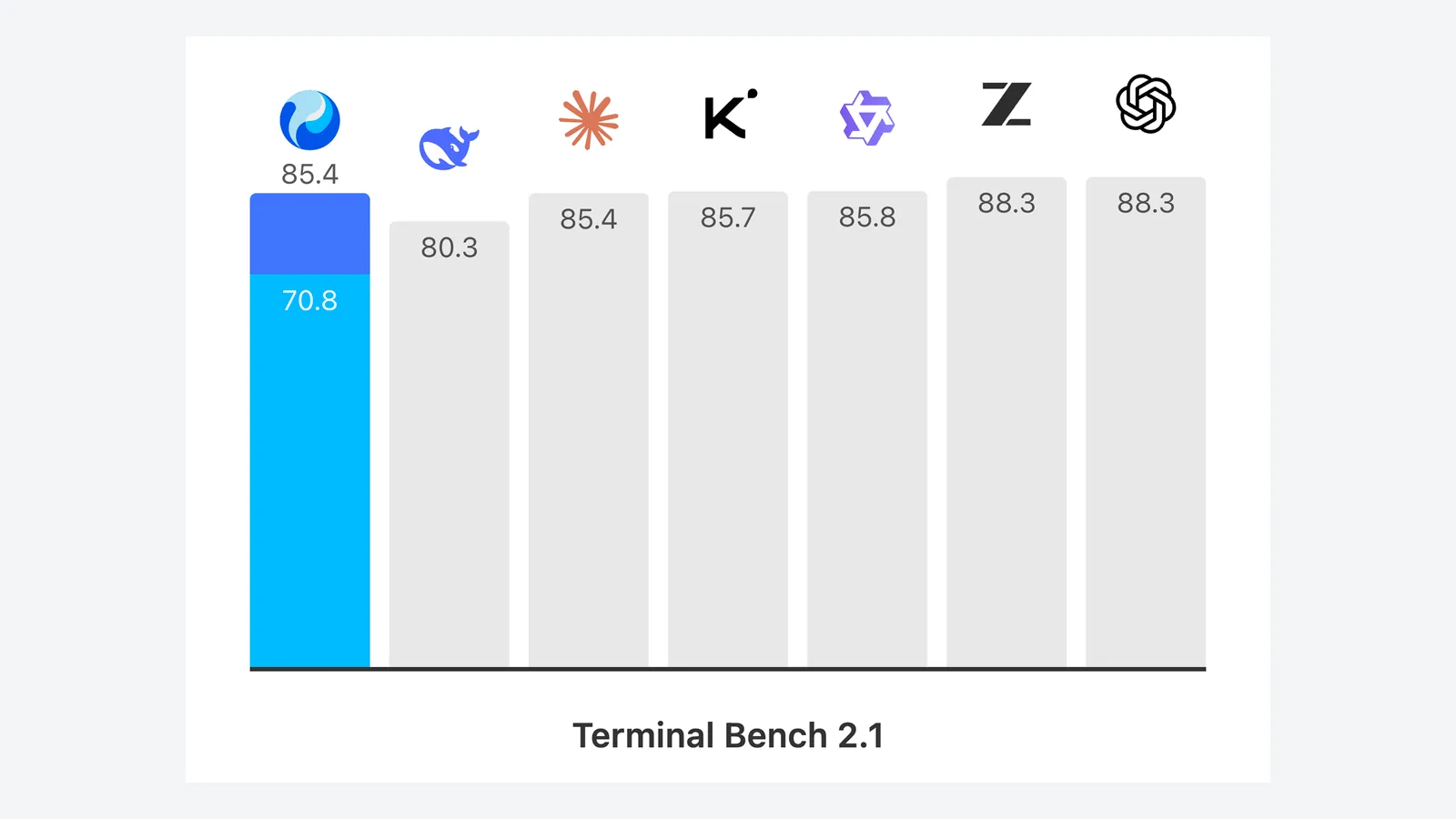
Read the public charts carefully and the picture is nuanced rather than dominant. On Terminal Bench 2.1 — the panel Tencent ships in its own repo header — Hy4 preview scores 85.4, with GLM-5.3 and GPT-5.6 Sol at 88.3 and Claude Opus 5 at 85.7. On Agents’ Last Exam (ALE-CLI) Hy4 leads the panel at 72.2, and on Toolathlon-Verified it posts 74.1. The honest summary: competitive at the frontier on agentic and coding tasks, ahead on some panels, behind on others, and every number here is self-reported pending independent replication.
Limitations — Unusually Candid
Tencent’s known-limitations section is refreshingly direct: this is an early version with “real headroom left,” models can spend “longer than necessary reasoning through complex tasks,” and there’s “a tendency to over-verify its own work.” Reuters flagged the same over-verification behavior. The team explicitly frames the release as ship-early-and-iterate, the pattern that (they say) made Hy3 better.
Add the structural caveats: a preview model may change materially before any stable release; internal expert panels are not independent evaluation; and at ~1.56 TB for BF16 weights, self-hosting requires serious hardware — the FP8 variant is the practical path for most teams.
What Developers Can Do
- Read the license first, then the benchmarks. If you need to embed, serve, or commercialize without legal friction, Apache 2.0 changes the calculus versus the custom GLM-5.3 and Kimi K3 licenses.
- Start from the FP8 repo unless you have multi-node capacity:
tencent/Hy4-preview-FP8is the deployment-friendly artifact. - Use the official vLLM/SGLang recipes — the MTP speculative config and
hy_v4parsers are documented, and the OpenAI-compatible endpoint exposesreasoning_contentfor chain-of-thought. - Stress-test the long-context claim on your own data before betting on the 1M-token window.
- Watch the CodeBuddy/WorkBuddy integration as the signal for where Tencent is taking the model in production.
What Happens Next
Three markers to watch: independent replication of the benchmark panels, the community’s local-deployment results at 49B-active economics, and whether “preview” graduates to a stable Hy4 — or whether the open-weights frontier simply moves again before it does. Either way, the licensing bar in the open field just moved: the flagship-tier conversation now includes a genuine Apache 2.0 option.